Free Shipping on Orders $99+
Use Code FLAT15 & Get 15% Off On All Orders
Choose your store
Prices, currency, and delivery follow the store you select.
Prices, currency, and delivery follow the store you select.
An Iowa event can change character quickly. A setup that begins on firm grass in the morning may be dealing with saturated ground after an afternoon storm, while a canopy stored after a humid market can carry enough moisture to create problems long after the event has ended. Add the distances between cities such as Des Moines, Cedar Rapids, Davenport, and Ames, and the canopy becomes equipment that needs to survive the entire event cycle rather than simply look good once it is assembled.
That changes what deserves attention when choosing custom canopy tents for Iowa. Fabric storage, frame construction, ground contact, transportation, display rules, and event-specific requirements all have a place in the buying decision.
The strongest setup is one that works before the event, during the event, and after teardown. Iowa's outdoor event calendar makes each stage important.
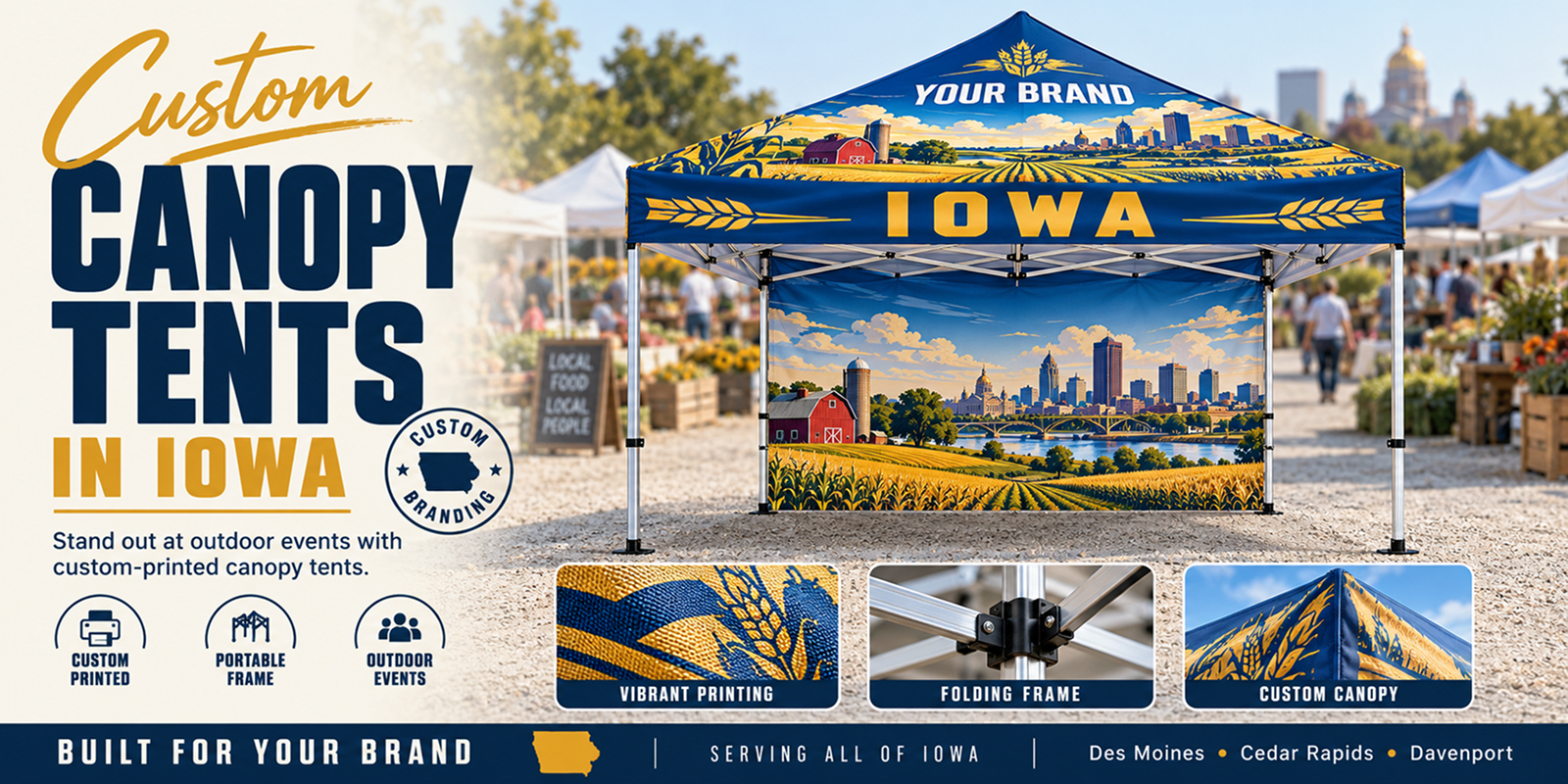
Instead of judging a canopy only by its appearance, consider what happens to it across a typical weekend.
| Stage | Iowa-specific concern | What to look for |
|---|---|---|
| Transport | Long drives between events and uneven loading surfaces | Wheeled carrying case and manageable frame components |
| Setup | Grass, compacted soil, gravel, or paved areas | Footplates and securing options suited to the assigned surface |
| Opening | Humidity and morning moisture | Fabric that can handle repeated outdoor exposure |
| Event hours | Sun, sudden rain, and changing conditions | Properly tensioned canopy fabric and useful wall configurations |
| Storm interruption | Strong gusts and heavy rainfall | Commercial-grade frame and immediate securing procedures |
| Teardown | Damp fabric | Complete drying before storage |
| Next event | Repeated assembly and transportation | Durable frame, organized components, and protective storage |
This lifecycle approach also makes a difference for recurring events. A canopy used once at a community gathering has different priorities than one traveling between a farmers market, a county fair, a sporting event, and a large exhibition.
Iowa's humidity creates an easily overlooked risk because the damage may appear after the event rather than during it. Morning dew, rain, and humid air can leave fabric slightly damp even when the exterior looks ready to pack.
The important purchase consideration is therefore not simply a water-resistant canopy. The entire storage routine needs to work with the fabric. A canopy that is folded and placed into a closed bag while damp can develop mildew, staining, and unpleasant odors, particularly when it remains packed between events.
Before packing
During storage
Before the next event
The product specification can support this routine, but it cannot replace it. A moisture-resistant fabric still needs to be completely dry before long-term storage.
The same canopy can sit on very different surfaces during an Iowa event. A downtown setup in Des Moines may use pavement, while a county fair outside the city can place the structure on grass or compacted soil. After heavy rain, the difference becomes even more significant because the ground itself can lose firmness.
| Surface | Main issue | Planning consideration |
|---|---|---|
| Pavement | Stakes may not be permitted | Use an approved ballast system |
| Firm grass | Ground anchoring may be possible | Confirm organizer rules before staking |
| Soft soil | Footplates can settle unevenly | Use broader support and suitable ground securing |
| Gravel | Uneven contact and movement | Prioritize stable foot placement |
| Wet grass | Reduced ground firmness | Recheck the structure after setup and during changing conditions |
A broad footplate can distribute pressure across a larger area than a small contact point, which can be useful when the ground is soft. The securing system still needs to match the manufacturer's instructions and the event's requirements rather than relying on improvised weights or hardware.
A canopy traveling around Iowa needs to tolerate repetition. The frame may be assembled, adjusted, collapsed, transported, and assembled again within the same week, particularly during periods when several community events or fairs fall close together.
Commercial-grade aluminum pop-up frames with telescopic legs can provide a practical balance between structural performance and portability. The frame should also have secure locking points so the setup can be adjusted without forcing the mechanism during assembly.
The frame is only one part of that system. Check the wheels, carrying case, wall attachments, connectors, and small hardware at the same time because a missing component can delay an entire booth setup.
The Iowa State Fair creates an especially useful example of why canopy selection cannot be separated from presentation planning. Its commercial exhibit criteria emphasize attractive, colorful, orderly, well-designed displays that fit the available space without crowding adjoining exhibitors. The Fair also requires buildings, tents, and enclosures used by contractors to receive Fair Board approval.
That makes the canopy part of the overall exhibit rather than simply a weather cover.
A strong display can use the available structure to establish visual recognition while keeping the visitor path clear. The Fair's rules also state that booth personnel must work within the confines of their booth and that business activities cannot extend into the aisle.
| Display requirement | Canopy implication |
|---|---|
| Stay within the contracted area | Confirm the actual footprint before choosing the size |
| Maintain clear visitor movement | Keep furniture and displays inside the assigned space |
| Present a professional exhibit | Use coordinated graphics rather than disconnected signage |
| Make the business easy to recognize | Give the roof and main wall a clear visual hierarchy |
| Avoid crowding neighboring exhibitors | Leave usable circulation space around internal displays |
The Fair also specifies a maximum booth height of 12 feet and requires merchandise prices to be visibly displayed in relevant commercial spaces.
These details matter when a canopy is being designed as part of a larger display. The printed structure should support the exhibit instead of consuming space that visitors need to move through.
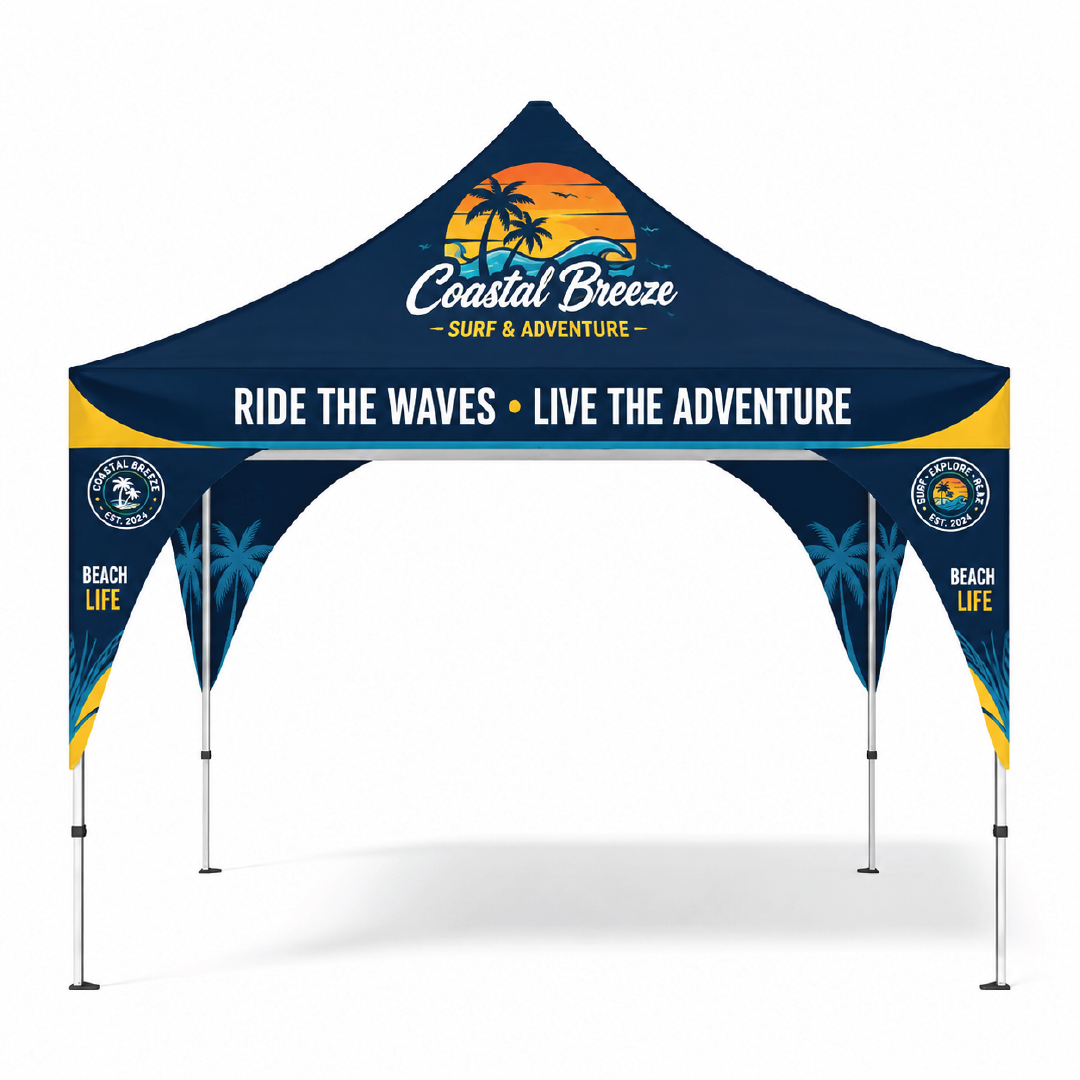
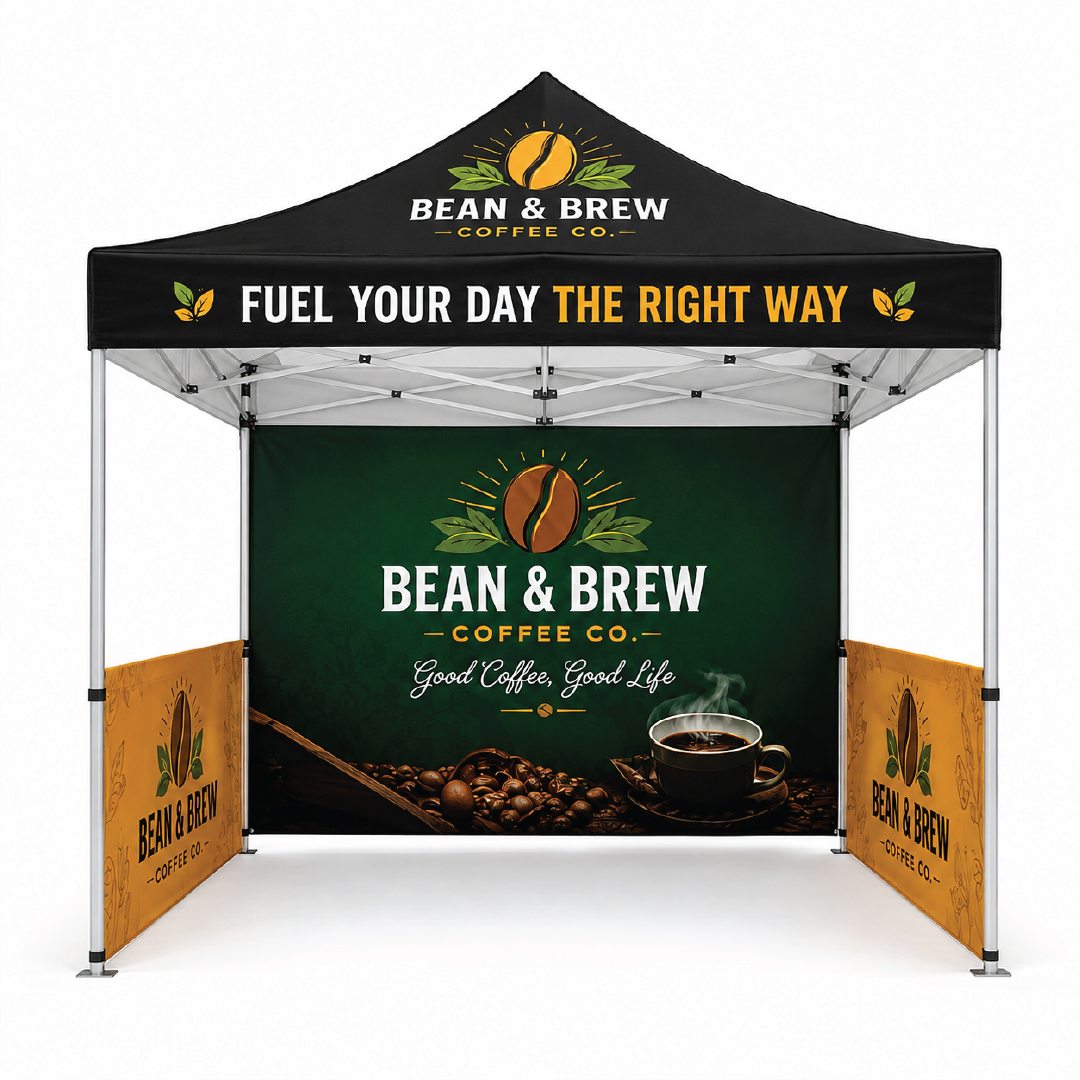
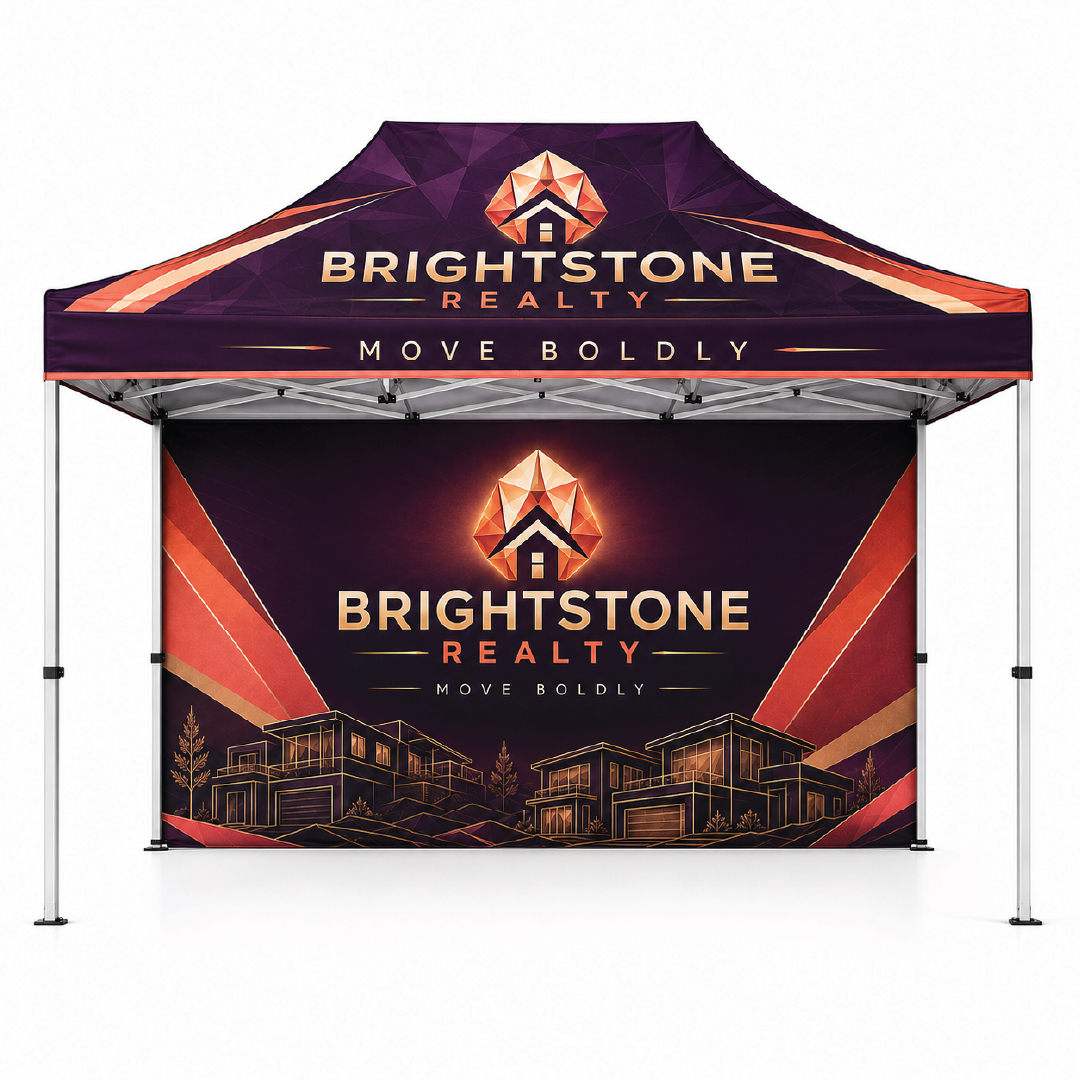
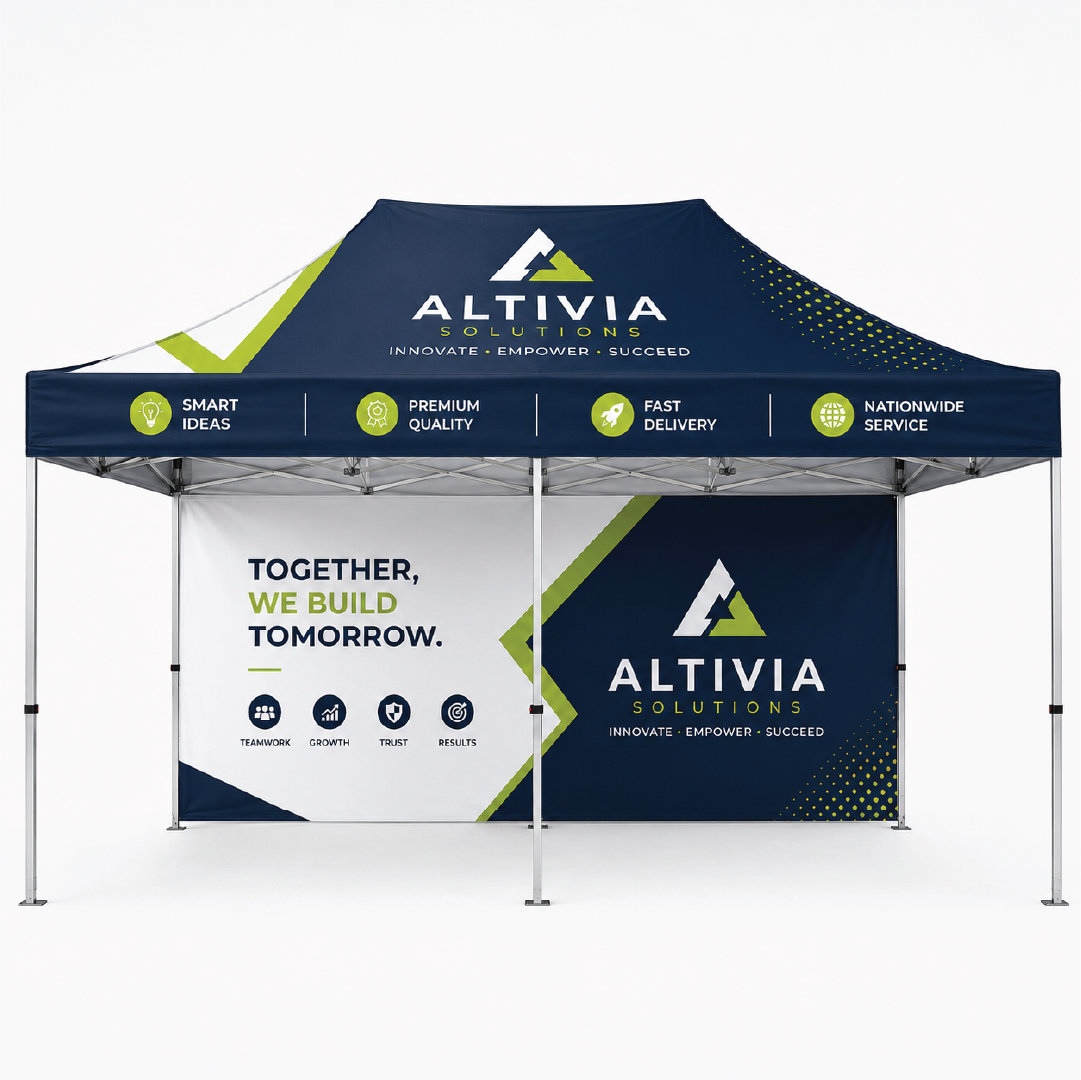
A printed canopy can communicate before someone reaches the booth. That makes the artwork particularly valuable at large outdoor events where visitors are moving past multiple displays.
Instead of covering every surface with information, assign each graphic area a purpose.
| Graphic element | Information priority |
|---|---|
| Roof | Brand recognition that can be seen above surrounding displays |
| Main wall | Primary campaign, product image, or company identity |
| Side area | Secondary message or supporting visual |
| Front edge | Short wording that remains readable at closer range |
| Additional flag | Long distance visibility when the event permits it |
Dye sublimation works well for this type of application because the artwork is integrated into the fabric. Printing Limitless uses dye sublimation on its printed canopy configurations, with 600D acrylic coated polyester available at an 8 oz graphic weight.
That gives the artwork a fabric-based finish suited to a display that will be folded, transported, assembled, and used repeatedly.
Iowa's summer storm environment creates a different type of operational concern than simple rainfall. A canopy can be perfectly stable during a calm afternoon and become vulnerable when a fast-moving storm arrives.
The response should be procedural rather than improvised.
1. Stop treating the canopy as a stationary display.
Secure the structure according to the manufacturer's instructions and the event's emergency procedure before conditions become difficult.
2. Remove loose display items.
Flags, lightweight signs, promotional materials, and unsecured equipment can create additional problems when wind increases.
3. Reduce exposed surfaces when instructed.
Wall configurations can influence how much wind reaches the structure, so follow the event organizer's instructions rather than making last-minute structural changes independently.
4. Follow the venue's evacuation or shutdown procedure.
A canopy should never be treated as a shelter during dangerous storm conditions.
The key purchasing lesson is simple: a commercial frame and suitable securing equipment provide preparation, but they do not turn a temporary canopy into a storm shelter.
The frequently repeated 400 square foot figure needs context. Iowa municipalities can establish their own permitting requirements, so buyers should not assume that one threshold automatically applies across the entire state.
Des Moines fire code provisions require a permit for tents and membrane structures with sides exceeding 400 square feet, while its provisions also address larger open-sided arrangements.
West Des Moines currently has its own published requirements and requires permits for tents over 200 square feet and canopies over 400 square feet, along with a site plan and flame retardant documentation for permitted structures.
North Liberty likewise requires a temporary tent and membrane structure permit for structures exceeding 400 square feet.
The practical takeaway is important for anyone buying a 10x20 canopy. Its 200-square-foot footprint does not automatically mean that every Iowa event treats it the same way. The venue, municipality, tent configuration, and event conditions can change the requirements.
Iowa's requirements can also extend beyond the canopy's physical size. West Des Moines requires a certificate of flame retardant treatment for each permitted structure, while Iowa administrative rules include NFPA 701 flame propagation requirements for certain tent applications.
That makes certification documentation a practical buying question.
When ordering a custom canopy tent, ask for the applicable flame certification information and keep it with the product records. Do not rely on a general statement that fabric is “fire resistant” when an event organizer or fire official requires specific documentation.
Iowa's event calendar can turn a canopy into traveling equipment. The distance between Des Moines, Cedar Rapids, Davenport, and other regional event locations makes transport part of the product experience, especially when the same setup is used repeatedly.
A wheeled travel bag can reduce the awkwardness of moving a collapsed frame across parking areas, fairgrounds, and paved walkways. The bag should protect the frame and fabric while keeping components organized so setup does not begin with a search for missing hardware.
The goal is not simply to make the canopy easier to carry. Good transport design protects the investment between events.
Different events require different levels of enclosure and presentation. A canopy used for a community market may need open visitor access, while a product demonstration may benefit from a strong rear graphic and controlled side coverage.
| Event environment | Configuration to consider |
|---|---|
| Farmers market | Open approach with clear brand recognition |
| County or community fair | Strong graphics with organized product display |
| Agricultural exhibition | Larger display area with practical visitor circulation |
| Sporting event | Compact footprint with quick access |
| Corporate activation | Coordinated walls and stronger visual branding |
| Demonstration space | Rear graphic with room for equipment and interaction |
The Iowa State Fair's commercial exhibit criteria specifically encourage active displays and demonstrations while asking exhibitors to fit their presentation into the available space without crowding.
That makes a canopy with a planned internal layout more useful than simply adding the largest available footprint.
Electrical planning can become part of the canopy layout when the display includes lighting, equipment, demonstrations, refrigeration, or other powered elements. The Iowa State Fair provides separate electrical ordering for vendors and assesses connections and equipment based on the service requested.
The canopy itself does not determine the electrical arrangement, but the booth layout should leave enough room for cables, equipment, access, and required safety clearances. Power requirements are best established before the display furniture and printed walls are finalized.
A useful purchase review can happen in five minutes if the right questions are already defined.
| Question | What the answer tells you |
|---|---|
| Where will the canopy be used most often? | Determines portability and configuration priorities |
| Will it be stored after damp events? | Makes fabric care and drying especially important |
| What surfaces will it encounter? | Determines the securing approach |
| Is it part of a formal exhibit? | Makes footprint and display rules more important |
| Will it travel between cities? | Makes the transport system part of the purchase |
| Will the display use electricity? | Requires layout and venue coordination |
| Does the event require fire documentation? | Determines which certification records need to accompany the canopy |
This approach keeps the product decision tied to actual Iowa use instead of selecting specifications in isolation.
An Iowa canopy earns its place when it remains practical after repeated setup, humid storage, long transportation, changing ground conditions, and demanding event schedules. The fabric needs a sensible storage routine, the frame needs to tolerate repeated assembly, and the display needs to fit the space rather than compete with it.
Printing Limitless offers custom canopy tents with dye sublimation printing, 600D acrylic coated polyester, aluminum pop-up frames, multiple footprint options, wall configurations, flags, toppers, weighted accessories, and wheeled travel bags. Those options can be combined around the type of Iowa event where the canopy will actually be used.