Free Shipping on Orders $99+
Use Code FLAT15 & Get 15% Off On All Orders
Choose your store
Prices, currency, and delivery follow the store you select.
Prices, currency, and delivery follow the store you select.
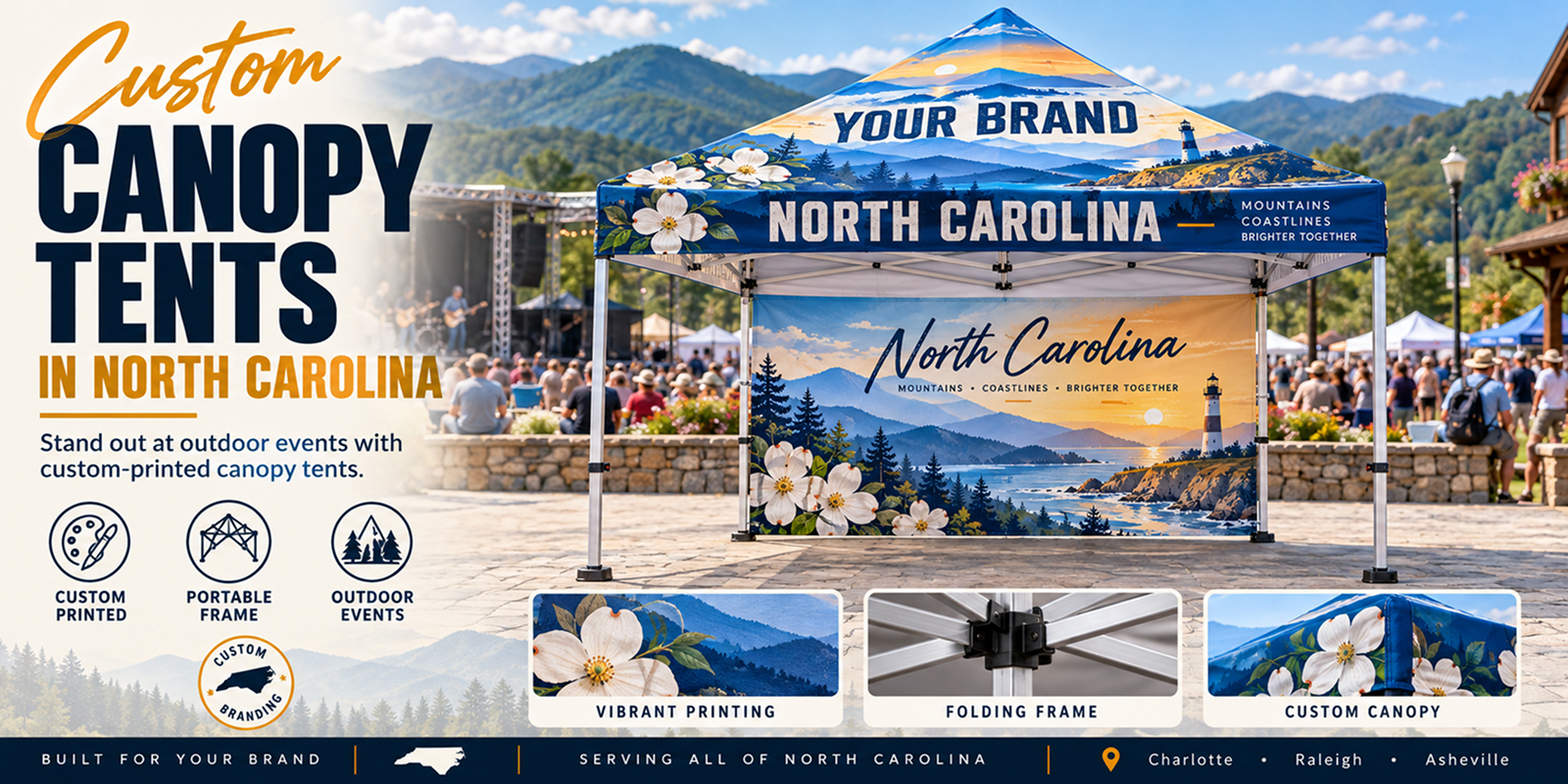
A canopy has a simple job that is to create a covered space outdoors. A well-planned canopy can do considerably more for a North Carolina business or event team. It can define a vendor area, create a recognizable meeting point, display a brand across a busy venue, protect products, and give customers a clear place to approach.
That matters in a state where outdoor activity can look very different across Charlotte, Raleigh, Durham, Asheville, Wilmington, Greensboro, and smaller communities. A farmers market setup may need an open front and quick access to products. A sports event may need branded walls and a registration counter. A company attending an outdoor expo may need a polished enclosure that can be packed away and reused.
The right custom canopy tent therefore starts with the event environment, available space, and intended use rather than simply choosing a size.
Before selecting a canopy, identify what the space needs to accomplish.
| Outdoor setting | What the canopy needs to do | Useful configuration |
|---|---|---|
| Farmers markets | Display products while keeping customer access open | 10 x 10 with open front |
| Craft and artisan markets | Create a branded retail environment | 10 x 10 with walls |
| Sporting events | Provide shade, registration, or sponsor visibility | 10 x 10 or 10 x 15 |
| Festivals | Help visitors identify a booth quickly | Full color top with topper or flag |
| Corporate events | Create a professional branded area | 10 x 15 or 10 x 20 |
| Food and beverage events | Provide shelter while supporting organized service | 10 x 10 or 10 x 20 |
| Beach and coastal events | Combine portability with outdoor protection | 10 x 10 beach canopy |
| Community events | Provide flexible shelter for repeated use | Solid color or custom canopy |
This approach also helps avoid buying a canopy that looks suitable on a product page but becomes difficult to use once tables, merchandise, staff, and customers occupy the space.
A custom canopy tent is best evaluated as a complete system rather than as a printed roof.
The main components usually include:
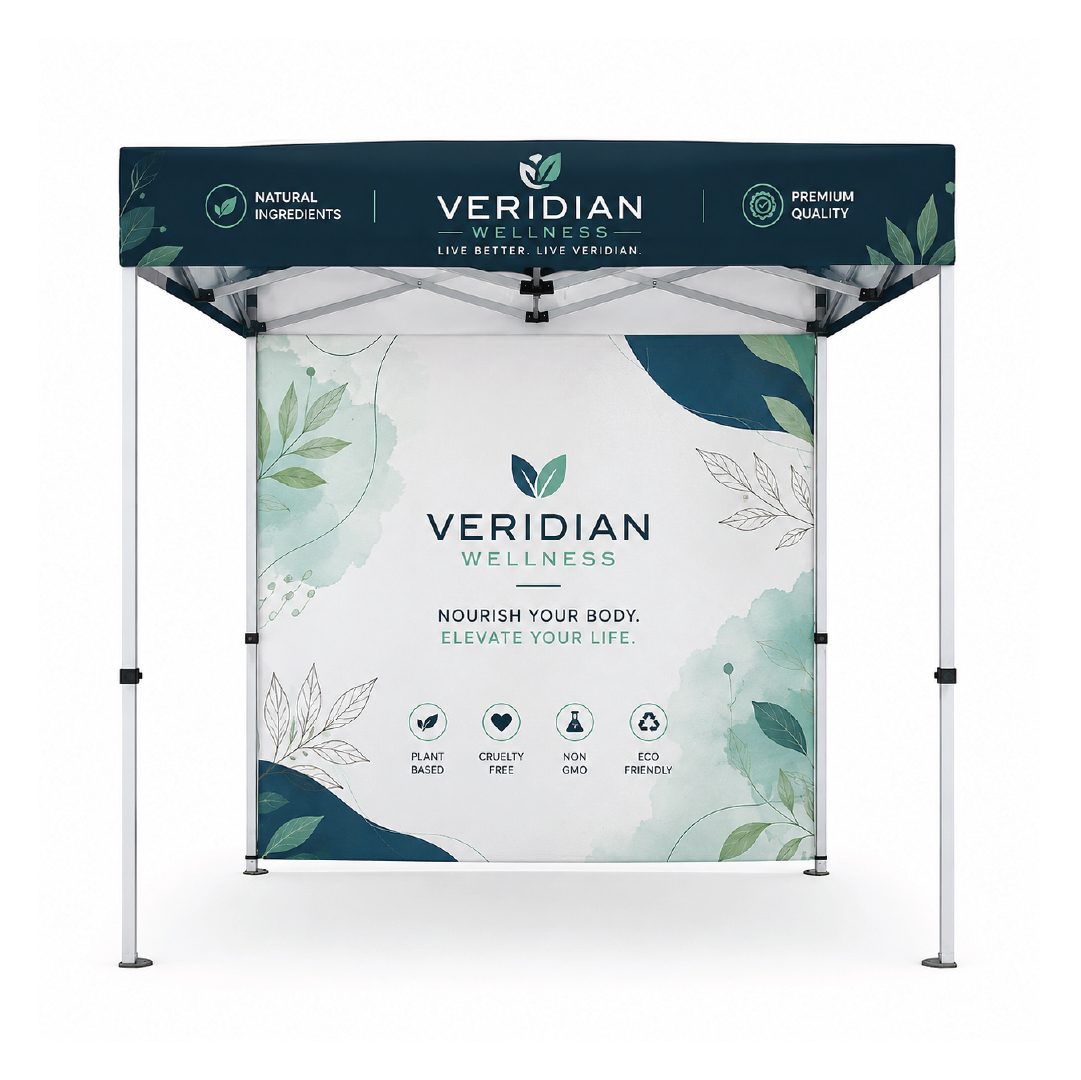
Printing Limitless offers custom canopy configurations with aluminum frames, dye sublimation graphics, and several size options, including 6 x 6, 10 x 10, 10 x 15, and 10 x 20 formats. Options can include walls, toppers, sandbags, and flag attachments depending on the model.
Size should be decided before artwork is finalized. A 10 x 10 canopy tent is a practical starting point for many vendors because it provides a 100 square foot footprint while remaining relatively manageable for transport and setup.
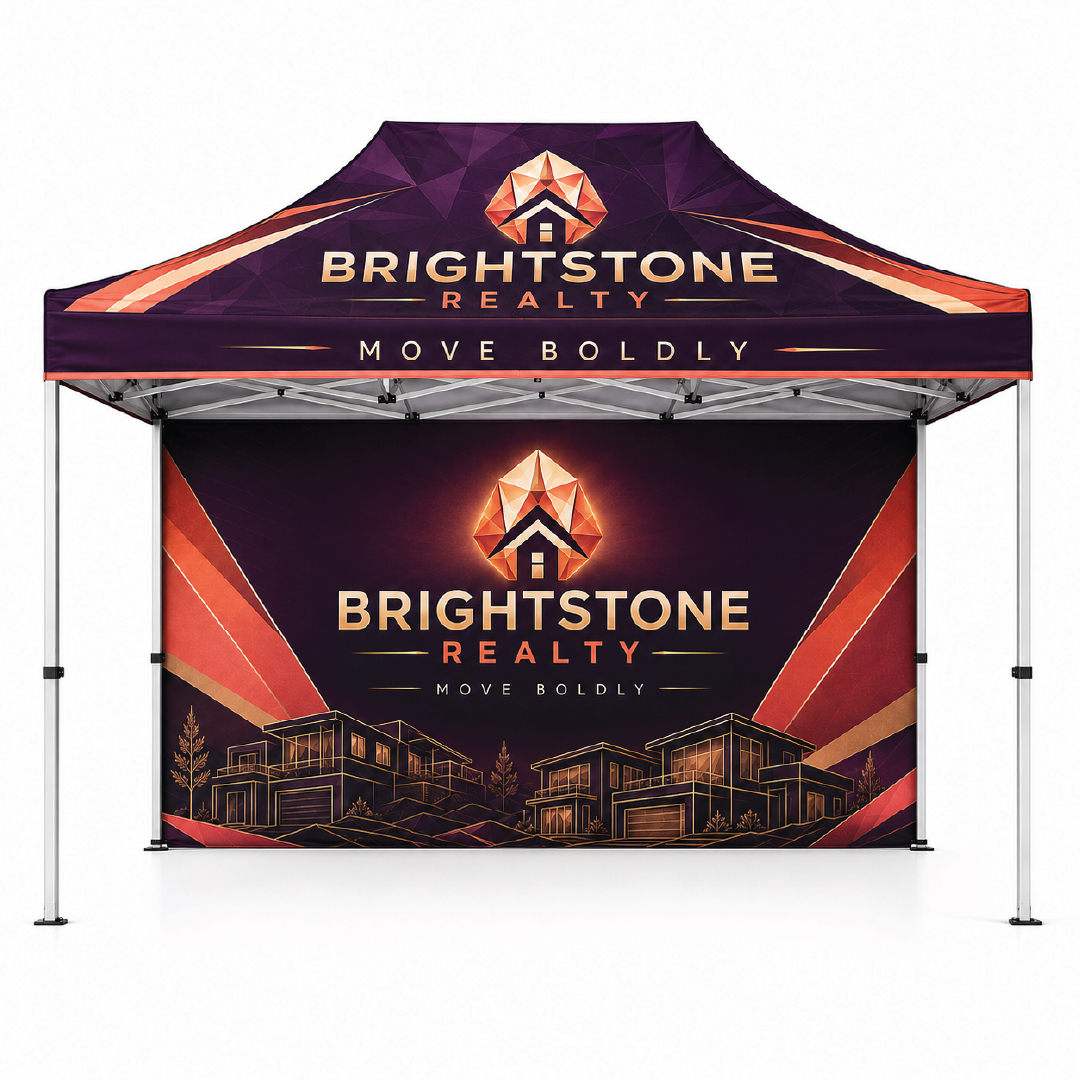
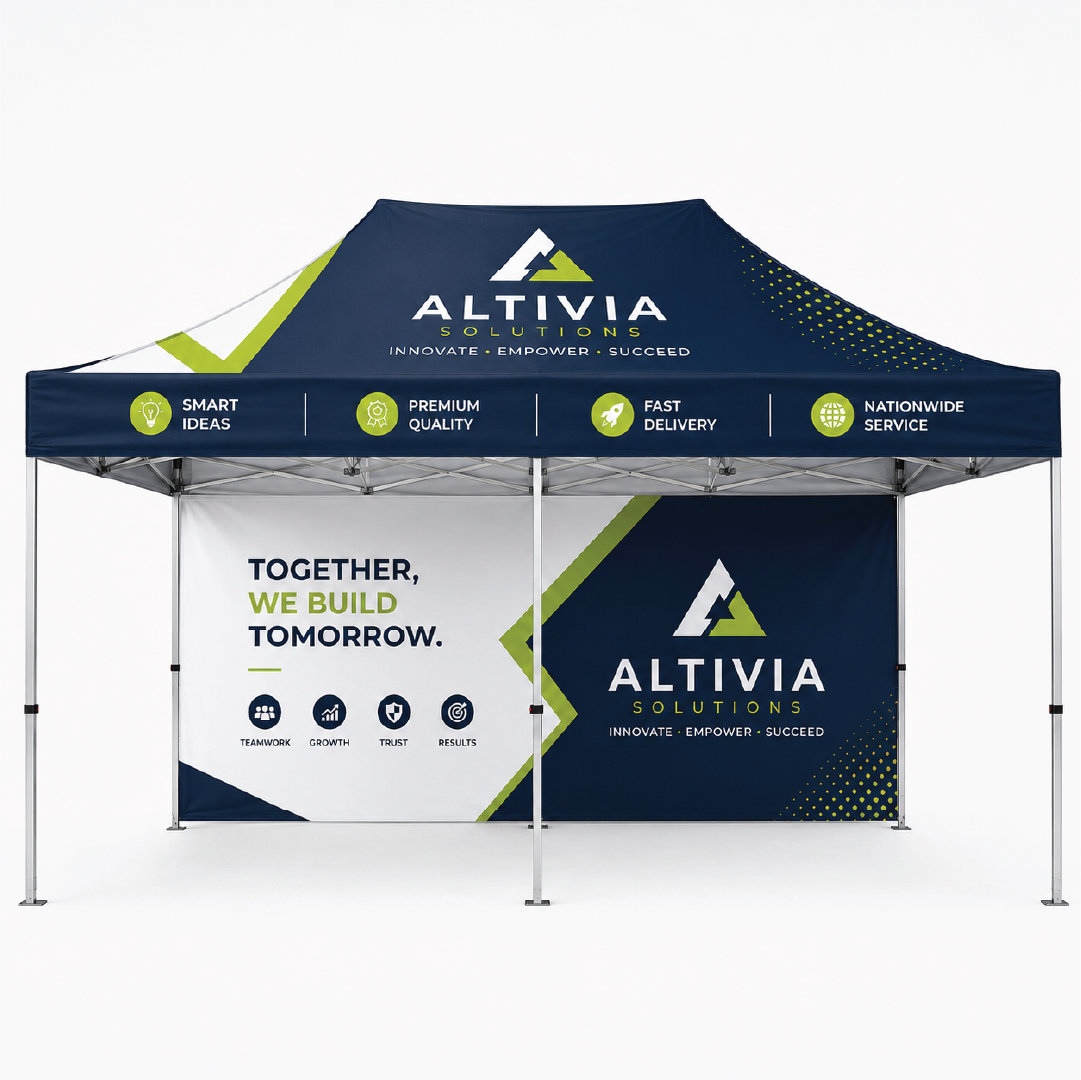
A 6 x 6 canopy works differently. Its smaller footprint can suit compact vendor spaces, information booths, and situations where floor area is restricted. A 10 x 15 canopy creates additional room for displays, staff movement or customer interaction. A 10 x 20 structure is better suited to businesses that need a larger branded environment or several functional zones beneath one roof.
A simple space calculation
Consider everything that must fit under the canopy:
Tables + display equipment + merchandise + staff movement + customer access = required usable space
Do not plan around the canopy dimensions alone. A 10 x 10 footprint can quickly feel crowded if several tables are placed inside and customers are expected to browse. For a larger corporate activation, a 10 x 20 configuration can allow the space to be divided into areas for product demonstrations, conversations, registration, or hospitality.
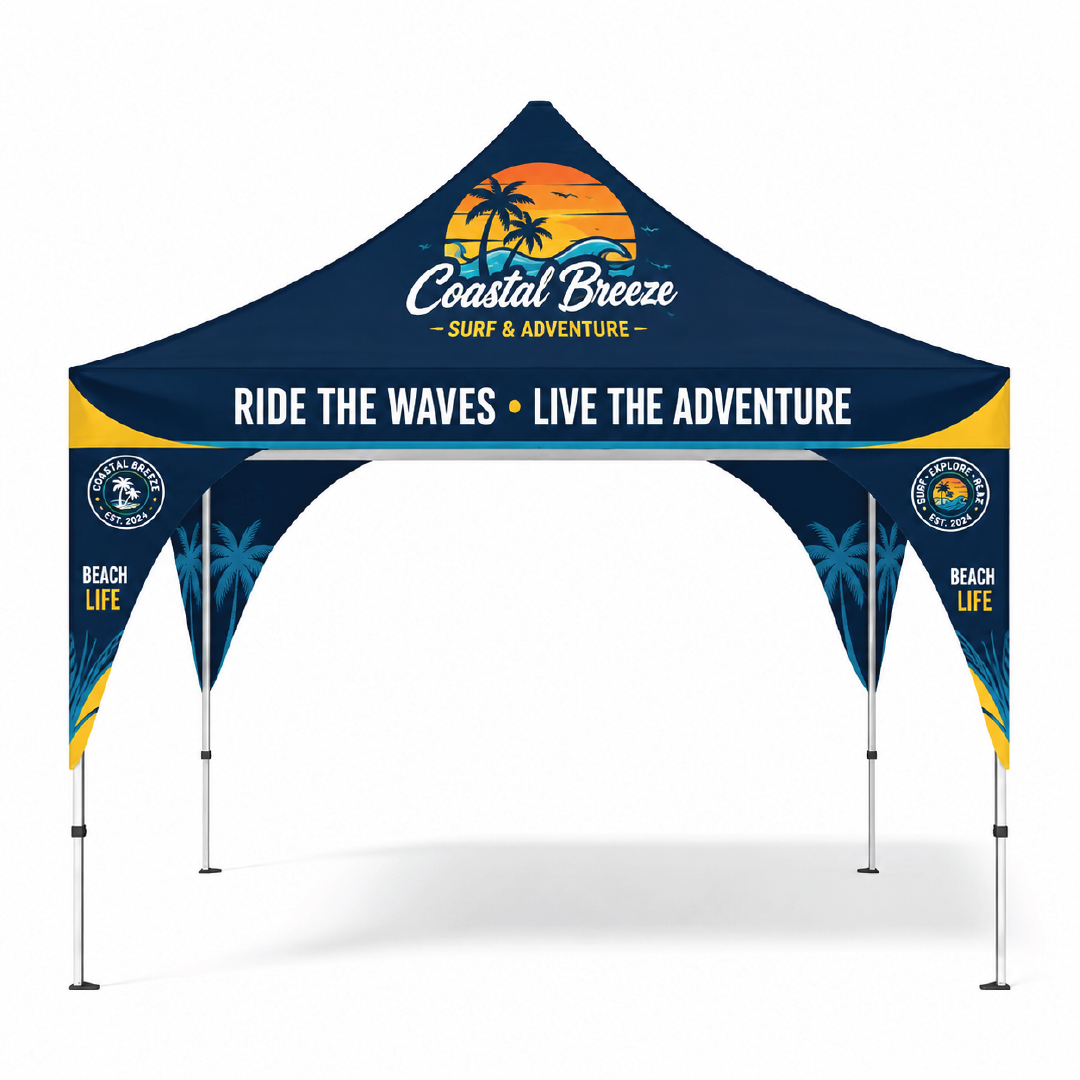
A branded canopy becomes easier to design when every visible surface has a purpose.
The roof is usually the largest branding surface. It should make the company recognizable even when visitors are several booths away.
A logo, short brand name,e or strong visual identity generally works better than filling the entire roof with small information.
The lower edge remains closer to eye level and can reinforce the business name, website or short message.
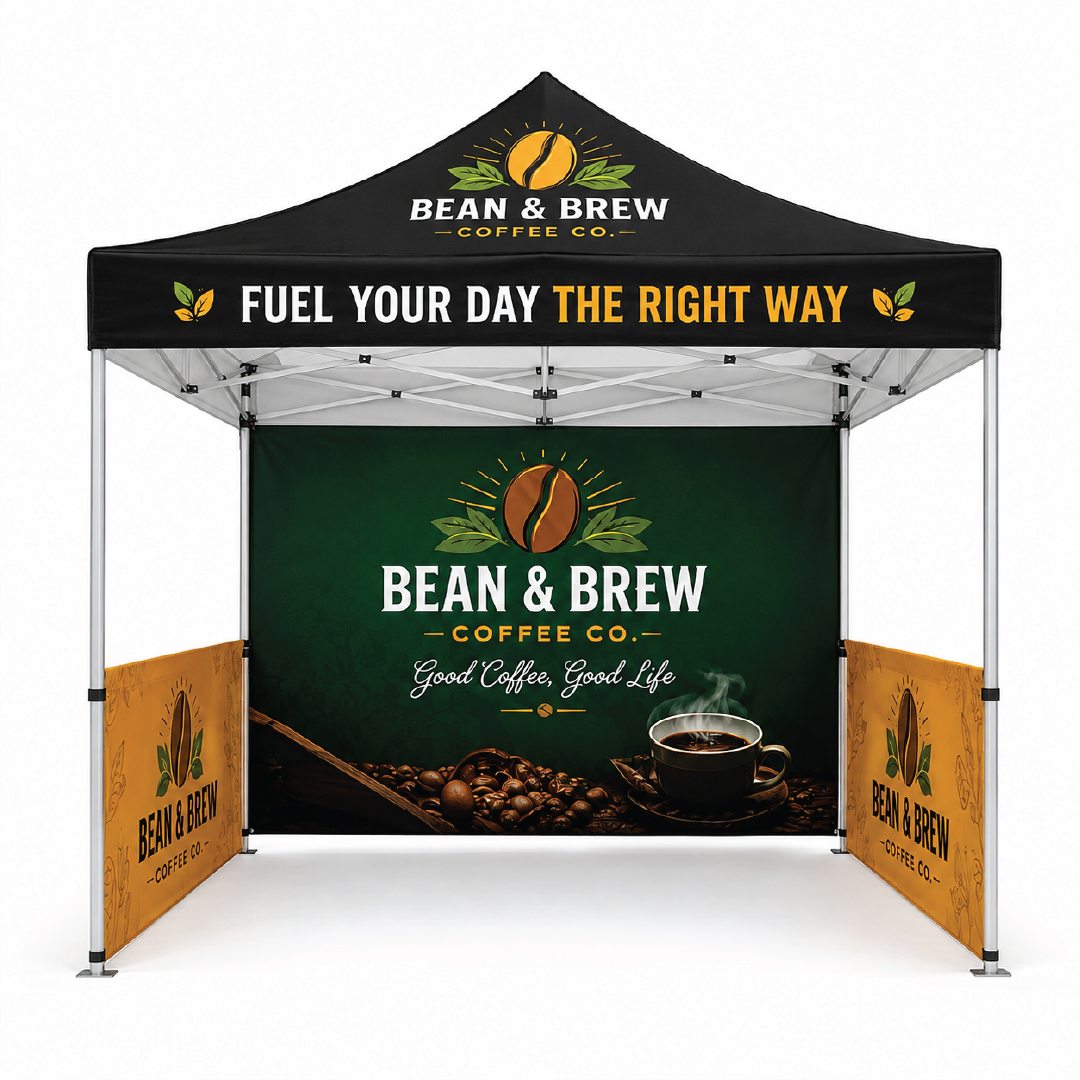
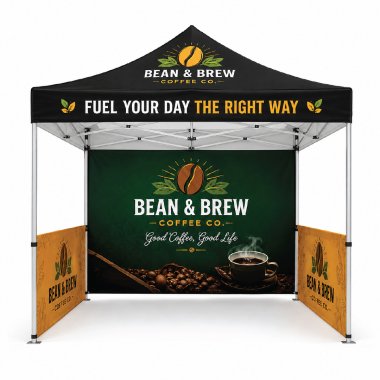
Walls create additional advertising space while changing how the booth functions.
A full wall can provide privacy or create a defined presentation area. A partial wall can separate equipment while keeping the customer entrance open.
A topper can act as a visual marker above the main canopy. This can be useful at large festivals, sports events, and trade environments where several exhibitors are positioned close together.
A teardrop flag can extend the visual footprint vertically and help people locate the booth before they reach it.
Outdoor graphics are rarely viewed at the same distance as a business card or website. A visitor may first see the canopy while walking past another booth. The logo therefore needs to remain identifiable without requiring someone to stop.
A useful visual hierarchy is:
Brand name → primary message → supporting information
Avoid treating every surface as an information board. For businesses attending recurring events in North Carolina, a flexible graphic system can also make future campaigns easier. The main brand identity can remain consistent while promotional elements change around it.
Printing Limitless supports full-color dye sublimation printing and Pantone color matching options, which can help businesses maintain consistent brand presentation across their canopy graphics.
This decision depends heavily on what happens inside the space.
| Setup | Useful for | Main advantage |
|---|---|---|
| Open front | Markets and public events | Easy customer access |
| One side wall | Product display | Adds branding without closing the booth |
| Two side walls | Registration and demonstrations | Creates a defined work area |
| Full walls | Corporate presentations and hospitality | Greater enclosure and visual control |
| Half panels | Compact displays | Adds structure while retaining openness |
A retail vendor in Raleigh may want shoppers to move directly toward a table. A company running demonstrations in Charlotte may prefer additional wall space to control the viewing area. The graphics should follow the function rather than forcing the function around the graphics.
A canopy roof can catch wind like a large sail. The frame, roof, and anchoring system therefore need to be treated as one setup.
There is no universal wind rating that can safely be applied to every pop-up canopy. Frame construction, roof configuration, sidewalls, anchoring, ground surface, and actual weather conditions all affect stability.
For North Carolina events, buyers should plan the anchoring system before arriving at the venue.
Sandbags or purpose-built ballast may be necessary when stakes cannot be driven into the ground.
Approved stakes and suitable anchoring methods may be available, subject to venue rules.
Sidewalls change how wind interacts with the structure. A configuration that works well as an open canopy should not automatically be assumed to have the same stability when fully enclosed.
Check the weather, inspect the anchors, and follow the manufacturer's operating guidance. If conditions become unsafe, the canopy should be taken down rather than treated as a permanent shelter.
North Carolina's geography creates different outdoor requirements. Coastal events around Wilmington and other beach communities can expose displays to sun, moisture, and changing wind conditions. An inland farmers market may place greater emphasis on compact setup, product visibility, and frequent transport.
Mountain events around Asheville can bring another set of considerations involving uneven surfaces, changing weather, and transportation. That makes configuration more important than simply selecting a popular canopy size.
For coastal promotional work, a custom beach canopy tent can be considered where the lower profile and beach-oriented construction fit the setting. Printing Limitless offers a 10 x 10 custom beach canopy with a steel frame, 300D polyester fabric, UV protection, water-repellent coating, and a wheeled carry bag.
A canopy that stays at one venue can be selected differently than one transported every weekend.
For mobile teams, consider:
The 10 x 10 custom canopy offered by Printing Limitless has an aluminum frame and a listed stand weight of about 37.48 pounds. The frame uses adjustable height positions, while optional walls, toppers, sandbags, and flag attachments can change the final setup. That makes the complete package worth considering before purchase rather than comparing the printed canopy alone.
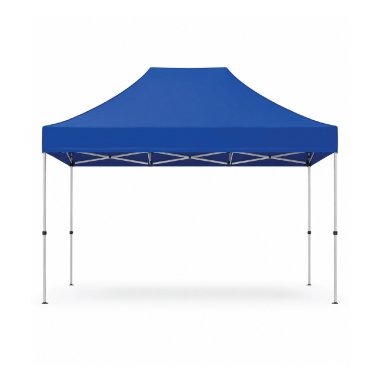
Not every event requires a fully printed structure. A solid color canopy tent can work when a business wants a clean shelter and already uses separate signage, banners or flags for branding.
A fully customized canopy makes more sense when the canopy itself needs to function as the primary visual identifier.
| Priority | Suitable approach |
|---|---|
| Basic outdoor shelter | Solid color canopy |
| Strong brand visibility | Fully custom canopy |
| Repeated trade events | Custom canopy with reusable graphics |
| Short promotional campaign | Custom canopy with campaign-specific graphics |
| Minimal display footprint | Smaller custom canopy |
| Large branded environment | 10 x 15 or 10 x 20 custom canopy |
This distinction can prevent unnecessary spending on graphics that the event does not actually need.
A canopy purchase does not automatically determine whether an event needs approval. North Carolina's current Fire Prevention Code contains specific requirements for tents, temporary structures, and outdoor assembly events. The statewide code includes permit thresholds for larger tents and temporary structures, along with requirements covering structural stability, anchorage, access, location, flame propagation performance, and event safety.
Local authorities can add their own processes. For example, Raleigh requires tent permits for structures exceeding specified size thresholds and asks for information such as site plans and certificates of non flammability in applicable cases.
Charlotte also advises event organizers to check permitting requirements for temporary structures. Tents on private property can require a zoning use permit, while larger public events can involve additional special event and inspection requirements.
The North Carolina Department of Administration also states that tents, canopies and other structures placed on state public grounds require an approved permit, with applications submitted to the State Construction Office within its specified event window.
Before ordering, ask:
This is particularly important for businesses attending organized festivals, public events, and large outdoor gatherings.
Food vendors should treat their canopy setup differently. North Carolina's Fire Prevention Code places specific restrictions on cooking equipment around tents and temporary structures. Cooking appliances that produce sparks, grease-laden vapors, or flying embers generally need separation from tents unless an applicable exception has been approved.
Charlotte's current event guidance also states that tents used for cooking must meet flame retardant requirements, maintain ventilation and separation, and have appropriate fire protection equipment. A food business should therefore confirm the event's cooking rules before choosing its canopy layout.
The canopy may need to accommodate:
Cooking area + service counter + customer queue + storage + fire safety equipment
That can require a different footprint than a standard retail display.
A reusable event kit can make repeated outdoor appearances much easier.
The exact kit will depend on the event. A craft seller may prioritize display fixtures, while a corporate team may need presentation equipment and seating.
One of the strongest reasons to invest in a custom canopy is repeat use. A business attending several events can use the same branded structure at a farmers market, community festival, sporting event, or corporate gathering.
For that reason, artwork should avoid overly specific event information when the canopy is intended for long-term use.
A strong permanent design can carry:
Temporary promotions can then be added through replaceable signage, tabletop graphics, or banners.
Outdoor graphics and frames last longer when they are stored correctly. Allow the fabric to dry completely before packing it away. Dirt can be removed with water, a soft sponge, and mild soap suitable for the material. Strong detergents and machine washing should be avoided where the product instructions prohibit them.
The frame should also be checked periodically for:
A small inspection before each event can identify problems while there is still time to repair or replace a component.
The right canopy is rarely determined by size alone.
A compact vendor booth may need maximum customer access. A corporate activation may need several walls and a stronger visual presence. A coastal event may call for a configuration suited to exposed conditions. A food vendor needs to consider cooking and fire requirements before planning the layout.
North Carolina buyers can therefore start with four practical questions:
Once those answers are clear, selecting the frame, size, graphics, walls, and accessories becomes considerably easier. Printing Limitless provides custom canopy options in multiple sizes and configurations, along with design proofing and designer assistance for businesses that want a branded outdoor setup prepared for recurring events across North Carolina.