
Custom Canopy Tents: A Complete Guide to Choosing, Using & Customizing Your Canopy
Choosing a custom canopy tent may seem like a simple task until you actually have to select one. You need to keep an eye on whether it:
- Is suitable for the space in which it is to be set up
- Has a good frame as per how frequently it’ll be used
- Is durable for the environment it will be in
Apart from these, there is also the appearance aspect of choosing one. The appropriate choice may differ substantially depending on the application as well. The more portable 6x6 canopy tent may be a good fit if you have a small space available. However, with the larger 10x10, 10x15, or 10x20 custom canopy tent, the pop-up canopy tent would offer more room to display your items and entertain guests. It would be ideal if the need to transport the tent is more important than the need for durability.
That is why choosing a canopy is no longer about getting a standard type but selecting one based on how it will be utilized. It becomes easier to narrow down the correct canopy before ordering when one examines these considerations.
What to Know About Custom Canopy Construction
The canopy tent is rather simple to construct. However, there are many little nuances that may play a role when you put it into practice.
- Frame Construction
Being the canopy’s primary support system, the frame requires much consideration. This is because aluminum is normally preferred for the construction of portable canopies due to its excellent strength-to-weight ratio. A good frame ought to be easy to carry while at the same time remaining strong after erection.
It is especially significant for large sizes. A 10x10 custom canopy tent can be very good for a small footprint at the event, but a custom canopy tent 10x15 or a custom canopy tent 10x20 will require a special frame due to the large coverage area.
- Canopy Fabric
The fabric dictates many of the things that the viewer will see and engage with. It needs to allow for proper coverage while also supporting clear and effective printing on the structure.
Weight of fabric, type of construction, quality of printing, and capability of being able to withstand outdoor conditions are things that should not be thought of individually but collectively. In cases where durability is the key consideration, the heavy-duty canopy tent would be the best option.
- Legs, Connections, and Stability
The adjustable nature of the legs will enable one to adjust the height of the canopy to different environments. Stability will also depend on the manner through which the canopy is fixed and its surroundings.
This is especially the case in open spaces where wind exposure could be greater. Hence, the canopy ought to be chosen keeping in view the environment it will be used in, rather than looking at the structure and material separately.
- Enclosure and Configuration Options
The canopy can also be designed to provide an enclosed area. Additional coverage, privacy, and branding can come from the use of walls and other panels for different occasions.
It is the design decisions that will ultimately determine how much utility the canopy will have apart from offering protection above. Once the proper sizing, material, and configuration of the structure have been determined, it can serve as both an effective event space and brand presence.
Choosing the Right Canopy Tent Size
The first choice that will have to be made is related to size, because the canopy will have to fit not only into the allotted ground space but also into the objects you are planning to set up under it. Small canopies will simply need space for a few people and some display, while others may have to accommodate more.
Have a quick look at the common sizes and where these canopy tents can fit:
| Canopy Tent Sizes | Best Suited For |
|---|---|
| 6x6 | Small displays, small promotional areas, and small spaces. |
| 10x10 | General event displays, vendor booths, trade show displays, and promotional displays. |
| 10x15 | Big displays, extra equipment, and bigger visiting areas. |
| 10x20 | Big displays, several activities, and displays requiring bigger coverage. |
| 20x20 | Large-scale event displays, VIP hosting, outdoor restaurants, group activities, and bigger covered areas. |
These measurements define the coverage of the canopy, but they are not the only things to consider. It is important to think about the surrounding area as well. It may be necessary to consider walkways, entrances, other booths, equipment, display stands, and even the anchorage area. A size that looks right on paper may actually be too small when taking into consideration the surrounding area.
One also needs to think about how the canopy will be moved and stored between performances. The larger the structure, the more space it requires when moving. Moreover, it will have to be stored in a separate place if it is not being used. When the canopy is being used at multiple locations on a frequent basis, it needs to be appropriate for transport and storage.
Canopy Materials, Features, and Durability
Material specs can certainly have a definite impact on the way the custom canopy tent performs when used multiple times outside. In addition to the basic structure, it is important to evaluate the material finish, protection properties, printing properties, and elements that help the canopy stay appropriate for various conditions.
Fabric Specifications to Check
- Fabric Weight
Thicker material will give more weight and will make the canopy more durable. It will be appropriate when using the canopy in outdoor conditions frequently. Proper choice of thickness will depend on its usage.
- 600D Polyester
The polyester fabric comes in 600D that has a tight weave surface for making custom graphics along with sufficient strength to be used regularly at events.
- Acrylic Coating
A coated surface of the tent with acrylic gives it extra protection, along with an appropriate surface for making graphics. It becomes necessary when the tent has to stay outdoors for long hours.
Protection Against Outdoor Exposure
- Water Resistance
An added coating may give the material more resistance against rain and water. The details provided by the manufacturer regarding water resistance can be found on the product specification sheet.
- UV Protection
Over a period of time, sun rays can have an adverse impact on both the fabric as well as the printed graphics. This can be prevented with the use of UV-resistant treatments. This can help you retain the appearance of your custom tent even during outdoor use.
- Color Retention
Dye sublimation printing is capable of creating very bright graphics that become incorporated into the fabric as opposed to being printed on top of the fabric surface. Print quality becomes an important factor if the canopy is intended for repeated use in promotions.
Safety and Environmental Considerations
- Flame Retardant
Some locations, trade shows, or other public events may have flame-resistant requirements. It is wise to check with the location beforehand to ensure that there will not be a problem with the type of material ordered.
- Eco-Friendly Fabrics
Eco-friendly fabrics can be used for purchasing when it becomes necessary to use less of the virgin raw material. Custom printed graphics are possible on such fabrics as well.
Features That Improve Everyday Use
Certain accessories can help increase flexibility in adapting the pop-up canopy tent in various locations and event types. The possible useful accessories include:
- Carry Bags: These will facilitate transportability and storage between events.
- Anchoring Accessories: These can assist in anchoring the tent in its appropriate environment.
- Wall Panels: These are helpful where there is a need for separation or enclosure.
- Clear PVC Panels: These will assist in achieving visibility yet provide a way of enclosing certain applications.
- Flag Holders and Flag Toppers: These will give additional areas for advertising.
- Sandbags: These offer an additional option for anchoring, suitable for outdoor applications.
Pop-Up Canopy Tents: Practicality and Portability
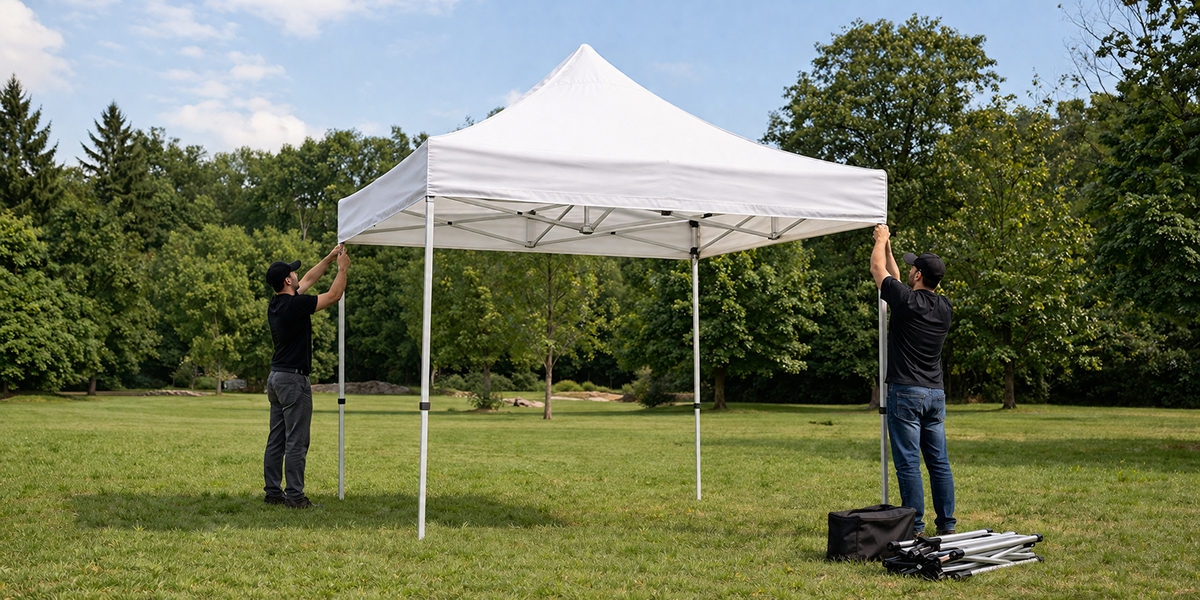
One of the major advantages of a custom pop-up canopy tent is its tool-free assembly. Unlike large engineered truss structures or pole tents that require structural engineers and complex anchoring systems, a modern pop-up canopy can be deployed by a small team in just a few minutes.
What Makes a Pop-Up Canopy Practical?
- Easy Transportation
The portable canopy can be transported to different locations using a proper travel bag. This is especially helpful for exhibitions and promotional activities that take place in different places.
- Compact Storage
Space considerations also play an important role between events. The canopy, which can be easily packed, consumes less space during the storage period.
- Reusable for Different Events
The 10x10 pop-up canopy tent can be used for a wide range of occasions, including trade shows, outdoor promotion events, community events, and others.
- Accessories for Different Setups
Accessories like walls, sandbags, flag poles, and carrying cases can increase the usability of the custom canopy tents in various event scenarios.
When Does Portability Matter the Most?
Portability is beneficial in cases where the canopy will be moved often, used in several places, or stored between uses. In such cases, weight, packing size, carrying technique, and accessories that are available become as important as the aesthetics of the canopy tent itself.
In addition, portability might be an appropriate choice in case of brand presence that requires consistency without permanent infrastructure.
Where Should You Use Custom Canopy Tents?
Canopies go way beyond being just basic protection from the elements. It becomes the blueprint to how you present yourself at the event entirely. The best design involves a smart computation of the square footage you have at your disposal, the amount of foot traffic anticipated, and how you intend to make use of the protected space. If it is a small space you are working with on a city sidewalk or a large space outdoors, size really does matter.
- Trade Shows and Exhibitions
The use of a custom canopy tent 10x10 can provide a useful place where one can exhibit products or logos at various trade shows or exhibitions. It is important to note that a canopy with a logo may be useful at any event to develop an identifiable presence.
- Outdoor Promotions and Community Events
A pop-up canopy tent can be used for any promotional events, community events, school events, and other local events that require coverage temporarily. A 10x10 pop-up canopy tent may be appropriate in cases when there is less space available.
- Large Outdoor Events
Large-sized tents can allow for bigger displays, equipment, seating, and more than one activity zone. For example, a custom canopy tent 10x15 will offer extra workspace, whereas a custom canopy tent 10x20 will be better for occasions requiring a considerably bigger covered area.
- Beach and Coastal Events
A canopy tent on beach sites requires paying proper attention to the environment surrounding it, available anchors, and the amount of space the tent would need. The use of the beach tent canopy could be useful to offer shade during promotions or events.
- Markets and Local Events
For situations where the space at hand is limited or where a smaller covered area is required, a 6x6 canopy tent would be effective. There might be a need for larger sizes where extra room is required.
- Outdoor Events Requiring Greater Durability
A number of events might require a tough canopy tent that can be used for several occasions. Factors like the weather conditions, the period for which it will be used, and the needs of the event itself must be considered rather than just its size.
Customizing Your Canopy for Better Brand Visibility
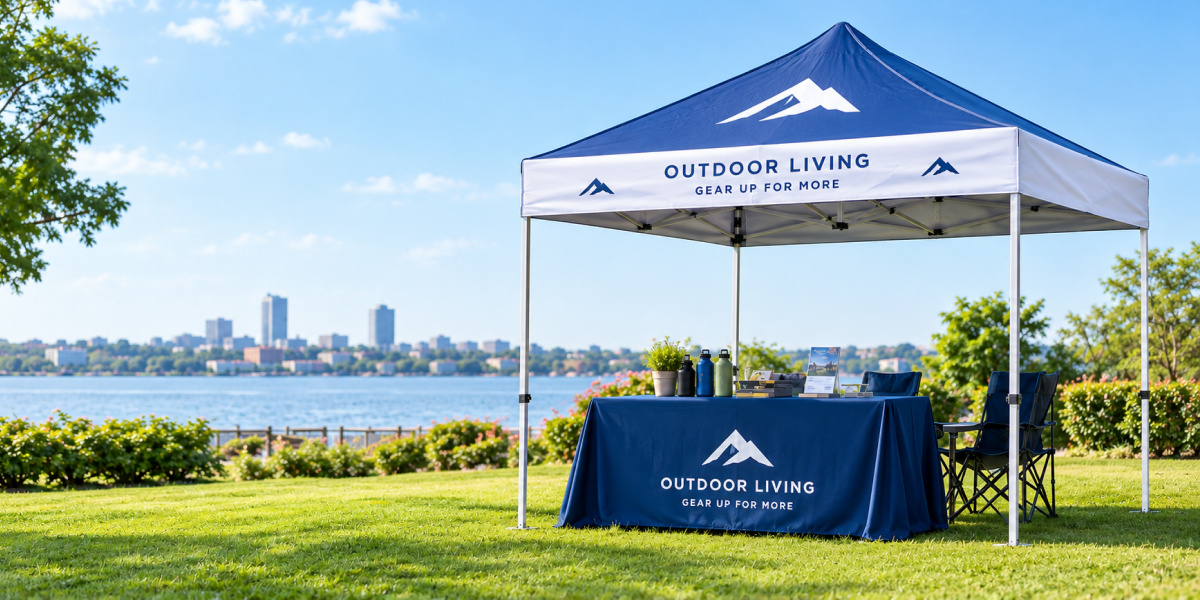
The custom canopy tent can transform into a branding medium if there is consideration of the visibility and readability of the message and how people will be approaching the area. The customization should ensure that the brand is easily identifiable yet does not clutter the canopy.
Build Around Your Core Brand Elements
Begin with the basic components that will need to be recognized first. These include a logo, brand name, color scheme, and short messaging for consistent visual branding throughout the canopy.
- Logo: The main logo must be prominently displayed with plenty of room around it for easy visibility.
- Brand Colors: Brand colors must be consistently used within the canopy design, like all other promotional items.
- Messaging: Messaging must be kept short for quick understanding of the purpose of the display.
Consider Where The Graphics Will Be Seen
Think about the viewing angles around the canopy before deciding where each element should go:
- Front-facing spaces: Use these spaces for your main logo, brand name, or main message as they are often the first areas to be noticed by visitors.
- Side-facing spaces: These spaces may be used for your secondary branding, brief messages, or graphics that would stay in view as visitors approach from various directions.
- Higher spaces: Logos and brands that are positioned higher up in the canopy will still be in view despite there being people, tables, or displays below.
Choose Graphics That Suit the Canopy
Art must be prepared with large format fabric printing in mind. Poor quality or low-resolution images can come out blurry when enlarged, whereas logos and high-resolution images turn out much clearer.
Dye-sublimation Printing: In this kind of printing, the design is actually infused in the fabric, hence appropriate for use in graphics, colors, logo prints, and full-color canopies.
Simple, Readable Layout: Bigger logos and readable lettering tend to be more effective than small text and complicated designs that may not be easy to read from afar.
How to Choose a Custom Canopy Based on Your Needs
The canopy can satisfy all the basic criteria on paper and still be a poor choice in terms of how it will be utilized. It is wise to evaluate the practical criteria around your event, transportation, storage, and future use prior to ordering.
Start With How Often You Will Use It
The frequency of use is one factor that could help in judging how practical it would be to consider long-term usefulness.
- Occasional Use: When the canopy will be used infrequently in a year, a simpler setup could suffice.
- Frequent Use: If the canopy is going to be used frequently, then it becomes more practical to consider easy transportation and storage.
- Recurring Campaigns: When a canopy is repeatedly used throughout the promotional cycle, it needs to be selected accordingly.
Consider How Long Each Event Lasts
The overall duration of an event can have a significant influence on the features.
- Short Events: The convenience of the canopy could be what matters most in such cases.
- Full-day Events: Visitor accessibility, working area, and useful accessories are things to consider.
- Long-term Events: The storage, maintenance, security, and appearance of the display are considerations that need more attention.
Account for Transportation Logistics
Take into account how high the canopy reaches when making the decision about your order. Make sure you know the size, weight, and the means of transport used for delivering it. If your event team will move the canopy by themselves, an easier option will help.
Plan for Storage Between Events
The available space for storage must also be taken into account along with the canopy. It should ensure that there is sufficient space for storing the packed canopy and its associated equipment without making them vulnerable to any environmental hazards.
Decide Which Features Are Worth Paying For
Not all options will carry equal value for every user. Therefore, you need to prioritize features based on the level of their usage.
- Essential: Features that you need for your regular events.
- Useful: Add-ons that make things convenient for multiple events.
- Situational: Features that become valuable only for certain venues/events.
Caring For and Storing Your Canopy Tent
With proper care and storage, you will be able to increase the usable life of your custom canopy and ensure that the fabric, graphics, and hardware are well-preserved for as long as possible.
The Maintenance Checklist
- Ensure that The Canopy is Completely Dry
Never store your canopy wet. Make sure that the fabric is thoroughly dried after any rain or washing to avoid any mold and mildew growth that might occur during storage.
- Use Gentle Cleaning Methods
To clean your canopy, use lukewarm water, mild soap, and a soft sponge. Do not use bleach, washing machines, harsh brushes, or any other cleaning products that may damage the fabric.
- Clean the Frame After Outdoor Use
Clean the frame and telescoping legs after outdoor use to get rid of dirt, sand, and other debris. Proper cleaning will make sure that moving parts are cleaner and easier to handle at future events.
- Maintain Moving Components
Periodically inspect joints, locking points, and sliding parts for dirt or stiffness. A good dry silicone spray may facilitate smoother operation without the attraction of further dirt or debris.
- Store the Canopy in Suitable Conditions
The canopy and frame should be stored in a dry and cool place when not in use. All components should be stored in a protective bag.
Elevate Your Brand with a Premium Custom Canopy
A good custom canopy tent does not have to be the biggest, strongest, or most expensive one out there. It is the one that will keep being relevant regardless of what events you are planning to throw, where you are setting them, or how you are presenting them.
Therefore, having a canopy becomes an element to consider as one of your event management tools instead of being seen as something just to use for temporary coverage. A canopy with a logo can eventually become your trademark, and the same structure is reusable for future promotions.
The custom canopy tents at Printing Limitless have all of these aspects incorporated into them. These can be found on our website, where you will be able to look at the various canopy tent options and choose the appropriate one based on your requirements.