Free Shipping on Orders $99+
Use Code FLAT15 & Get 15% Off On All Orders
Choose your store
Prices, currency, and delivery follow the store you select.
Prices, currency, and delivery follow the store you select.
A banner that survives a mainland summer without issue can start failing within weeks once it reaches an island. Not because the heat is worse, and not because the sun is necessarily stronger everywhere else too, but because Hawaii combines several forces most banners never have to face together at once. What actually breaks down first, and why does it happen so much faster here than almost anywhere else in the country?
The answer starts with salt. Trade winds carry ocean spray across every part of every island, and there is no location on land more than a short drive from that exposure. Add humidity that sits above 70 percent for most of the year, UV intensity that ranks among the highest in the United States, and sudden tropical rain that can arrive with almost no warning, and a custom vinyl banner printed for Hawaii is really being asked to survive four separate climate challenges layered on top of each other.
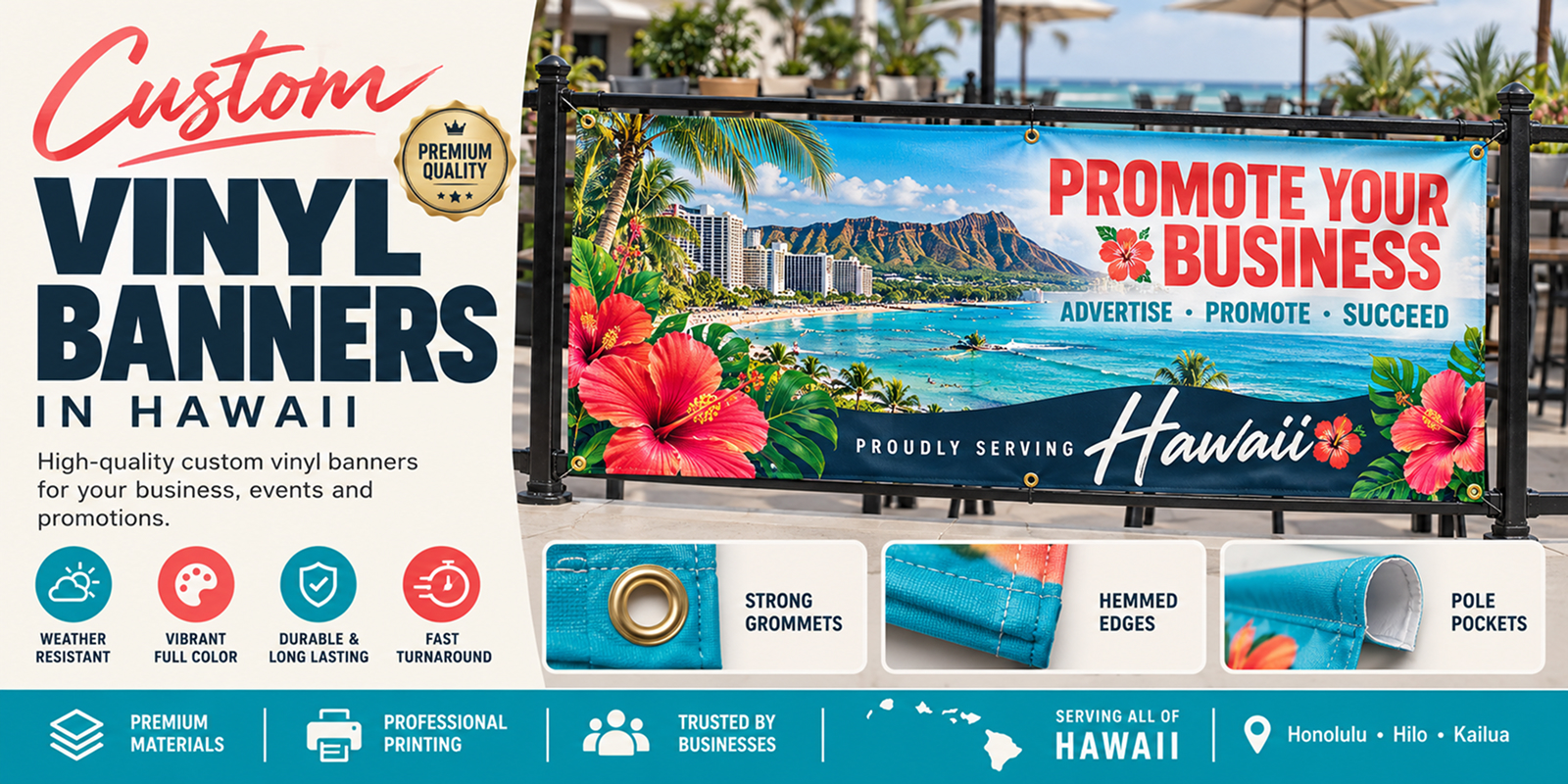
Salt air is often the first thing to cause visible damage, and it does not need a coastal location to do it. Because Hawaii's islands are narrow, ocean spray reaches inland areas that would feel far from the coast almost anywhere else. Metal hardware corrodes faster, adhesives weaken sooner, and lightweight material can start showing wear well before it would on the mainland.
| Climate factor | What it does to signage | What helps |
|---|---|---|
| Salt air from trade winds | Corrodes metal hardware, weakens adhesives over time | Reinforced grommets, wind flaps that reduce strain |
| High humidity (above 70 percent) | Encourages mildew, weakens lightweight material | Heavier PVC material, proper storage between uses |
| Intense UV exposure | Fades color, causes cracking over time | UV-resistant printing and material |
| Sudden tropical rain and wind | Puts stress on mounting points during storms | Wind flaps, secure grommet placement |
None of these factors are unique to Hawaii on their own. What is unique is having all four working on a banner at the same time, year-round, which is exactly why outdoor vinyl banners for Hawaii businesses need to be specified differently than banners heading to a drier, cooler mainland state.
Hawaii's weather changes dramatically over short distances because of how trade winds interact with volcanic mountains. Moist air hits the windward side of an island and drops heavy rain, while the leeward side, sheltered by the mountain, stays dry and sunny. That single pattern explains why Hilo, on the windward side of the Big Island, is one of the wettest cities in the entire country, while Kailua Kona, on the leeward coast of that same island, stays dry enough to grow coffee.
| Location type | Typical conditions | What it means for a banner |
|---|---|---|
| Windward coastal towns (Hilo) | Frequent heavy rain, high humidity, lush vegetation | Prioritize UV-resistant, moisture-resistant material |
| Leeward coastal towns (Kailua Kona) | Drier, sunnier, strong direct UV exposure | Prioritize UV-resistant printing and fade-resistant color |
| Urban centers (Honolulu, Waikiki) | Dense foot traffic, salt air, tourism-driven signage needs | Prioritize durable mounting for high visibility storefronts |
| Upcountry and higher elevation areas | Cooler temperatures, stronger and more consistent wind | Prioritize reinforced grommets and wind flaps |
A business ordering a banner for a Honolulu storefront is not necessarily solving the same problem as a vendor setting up near Hilo for a rainy festival weekend, even though both orders are shipping to the same state.
Honolulu, on Oahu, is Hawaii's largest city and its commercial center, where Waikiki's dense retail corridor and a steady flow of visitors keep demand high for storefront banners and event signage year-round. The Aloha Festivals, held each September across Oahu, bring parades and cultural events that create a short-term rush of demand for event banners and sponsor signage.
Hilo runs on a different rhythm, centered around the Merrie Monarch Festival each spring, one of the most significant hula competitions in the world, drawing performers and visitors from across the Pacific into a city that averages well over 100 inches of rain a year. Signage here has to be planned around near-constant moisture rather than just occasional storms.
Kailua Kona, on the drier side of the Big Island, hosts the Ironman World Championship each October, filling the town with athletes, spectators, and vendors who need banners that can handle direct tropical sun for days at a stretch without fading.
Choosing Material for Hawaii's Combined Climate Load
Printing Limitless offers Elite PVC Flex in two weights, and in Hawaii the decision usually comes down to how long the banner needs to survive outdoors and how close it will sit to the coast.
The heavier material tends to earn its keep quickly in Hawaii, where a banner is rarely dealing with just one weather challenge at a time.
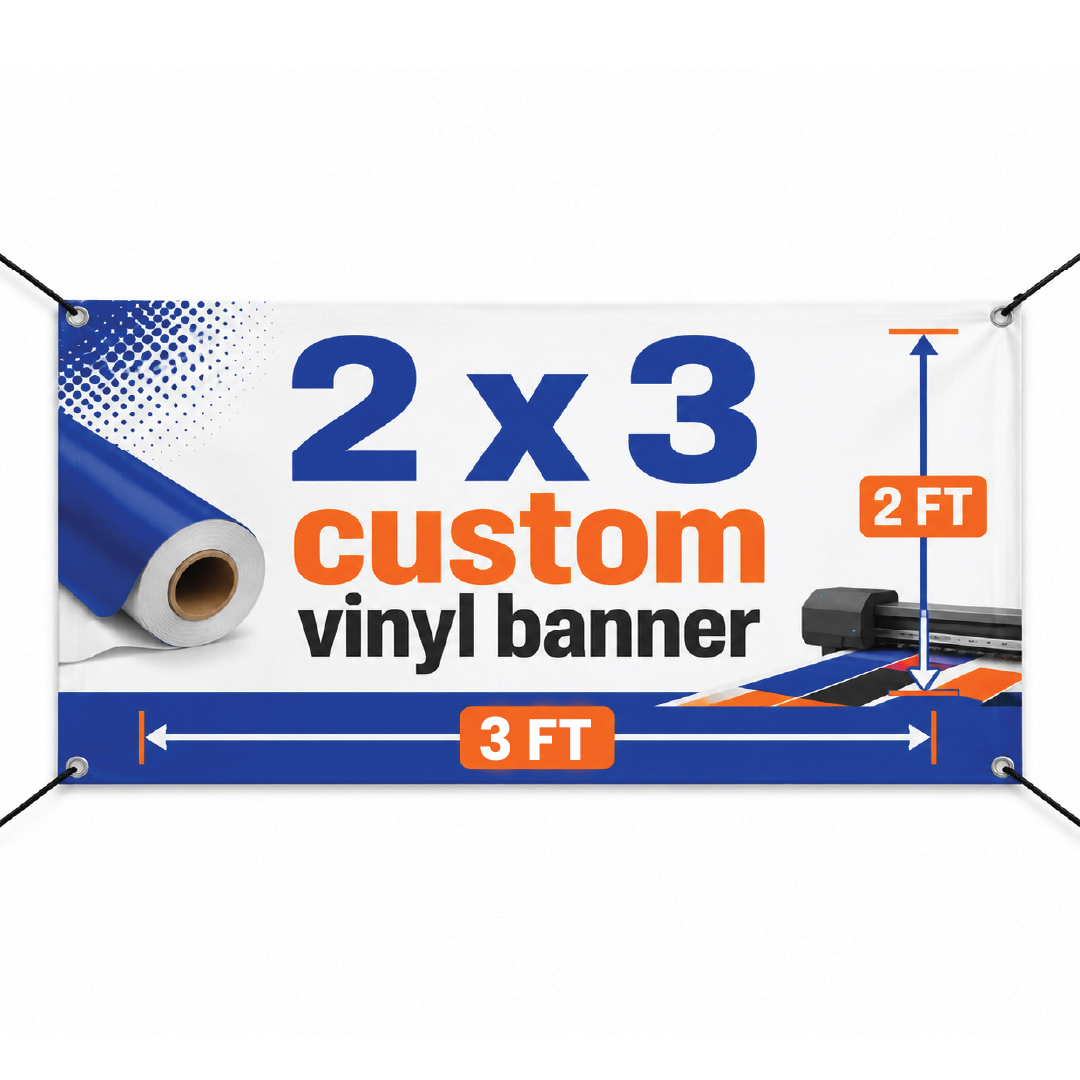
Printing Limitless offers standard sizes as well as fully custom dimensions, with a size tolerance of plus or minus 0.5 inches on every order.
| Width | Height |
|---|---|
| 3 ft | 2 ft |
| 2 ft | 3 ft |
| 3 ft | 4 ft |
| 4 ft | 3 ft |
| 3 ft | 6 ft |
| 6 ft | 3 ft |
Any banner over 10 feet in either direction is produced in multiple sections and joined together during production, useful for larger festival or resort-scale installations where a single standard size will not cover the space.
Wind is a daily reality in Hawaii, not an occasional weather event, and the right hanging hardware matters more here than in calmer climates.
| Option | Added cost | Best for |
|---|---|---|
| No grommets | Included | Banners going into a frame or track system |
| Metal grommets | Included | Standard fence, wall, or frame mounting |
| Pole pocket, top only | +$0.70 | Simple pole hanging setups |
| Pole pockets, top and bottom | +$1.40 | Secure vertical pole mounting |
| Pole pockets, left and right | +$1.40 | Horizontal pole or fence line mounting |
| Strong adhesive grommets | +$4.99 | Surfaces where drilling or punching is not possible |
| Wind flaps | +$9.99 | Open, windy sites where airflow needs to pass through |
Wind flaps are worth serious consideration for anything installed near the coast or in an open, elevated spot. Hawaii's trade winds blow consistently rather than occasionally, and letting air pass through the material instead of pulling directly on the grommets reduces the everyday wear that leads to early tearing.
Single-sided banners come standard with a white front and gray back. Double-sided printing suits freestanding displays at markets, festival booths, or resort entrances where visitors approach from multiple directions, common at events like Aloha Festivals or a busy farmers market. Full color printing runs at 720 DPI eco solvent output on the 13 oz material and 600 DPI UV output on the 16 oz option, both built to hold vivid, saturated color, which matters for a state where visual branding often leans into bright, tropical palettes.
Hawaii's UV exposure is intense enough that color choice becomes a durability question, not just a design one. Deep, saturated tones and high-contrast layouts tend to hold their vibrancy longer than pale or washed-out palettes under constant direct sun. For businesses maintaining a consistent look across multiple islands or locations, Pantone matching is available to keep brand color accurate from one order to the next.
Printing Limitless supports a few different paths to a finished banner. Upload print-ready artwork directly, build a layout using the online design tool, or work with a professional designer for projects that need extra creative support. Supported file types include JPG, JPEG, PNG, GIF, WEBP, PDF, CDR, SVG, AI, EPS, TIFF, and PSD.
Clean the vinyl with a soft, damp cloth and avoid cleaning agents entirely, since harsh chemicals can react poorly with salt residue already sitting on the surface. Because Hawaii's humidity rarely drops for long, a banner should be fully dry before being folded away, and it should be stored somewhere genuinely dry between uses rather than a garage or shed that holds onto moisture. Businesses reusing the same banner for an annual festival or seasonal promotion get noticeably more life out of it by building that habit in early.
Hawaii's hurricane season runs roughly from June through November, and while a direct hit is uncommon, tropical storms and heavy rain events are not. A banner installed during these months should be treated differently than one going up in the calmer winter stretch. Secure mounting matters more, lighter material becomes a riskier choice for anything staying up more than a few days, and businesses running seasonal promotions during peak storm months should plan for the possibility of taking a banner down early rather than leaving it exposed through an approaching system.
| Season | Typical conditions | Planning consideration |
|---|---|---|
| June through November | Higher chance of tropical storms, heavy rain | Favor reinforced mounting, monitor forecasts closely |
| December through May | Calmer trade wind patterns, less storm risk | Standard mounting is usually sufficient |
This does not mean signage has to come down for half the year. It means a business running a banner through summer or fall benefits from choosing the heavier material and secure grommet placement from the start, rather than discovering the gap in planning when a storm is already approaching.
| Business or setting | Common banner purpose |
|---|---|
| Retail store or boutique | Grand opening, sale, seasonal promotion |
| Restaurant or beach bar | Event promotion, seasonal menu, happy hour signage |
| Hotel or resort | Guest information, seasonal activity promotion |
| Tour operator or dive shop | Booking promotion, seasonal schedule announcement |
| Farmers market or craft vendor | Booth identification, product branding |
| Festival organizer | Entrance signage, sponsor recognition, directional displays |
| Real estate business | Property availability, contact information |
| School or community group | Local events, fundraising, cultural celebrations |
Island crowds move differently depending on setting, slower and more relaxed along a Waikiki sidewalk, faster and more purposeful at a festival with a schedule to keep. Either way, a banner trying to communicate too much at once usually gets skipped entirely. Lead with the one detail that matters most, a business name, an event name, a promotion, or a direction, and let secondary information sit in a smaller supporting role.
Every order accounts for the layered climate conditions a Hawaii banner actually has to survive, not a generic outdoor rating built for a milder mainland state. Printing Limitless offers custom vinyl banners using 13 oz and 16 oz Elite PVC Flex, full-color eco-solvent and UV printing, custom dimensions, single- and double-sided options, and mounting choices built for consistent trade wind exposure, along with professional design support when a project calls for it.
A storefront banner in Waikiki, a festival sign for Merrie Monarch in Hilo, an event banner for Ironman week in Kona, or a durable sign for a tour operator anywhere in between can all be built around what Hawaii's climate actually demands.