Free Shipping on Orders $99+
Use Code FLAT15 & Get 15% Off On All Orders
Choose your store
Prices, currency, and delivery follow the store you select.
Prices, currency, and delivery follow the store you select.
Kentucky gives custom banners plenty of practical uses across business, tourism, sports, equestrian events, festivals, retail promotions, and community activities. The challenge is rarely finding a reason to use a banner. It is making sure the finished display communicates clearly, fits its surroundings, and works for the duration of the planned campaign or event.
A banner beside a Louisville storefront has a different communication job than signage at a Lexington horse event or promotional graphics at a community festival in Bowling Green. The artwork, dimensions, placement, and production choices need to reflect that setting.
Printing Limitless produces custom vinyl banners in Kentucky for indoor and outdoor applications, with options covering custom dimensions, PVC Flex materials, printing configurations, finishing, and design support. The ordering process can also accommodate artwork supplied later when the design is still being prepared.
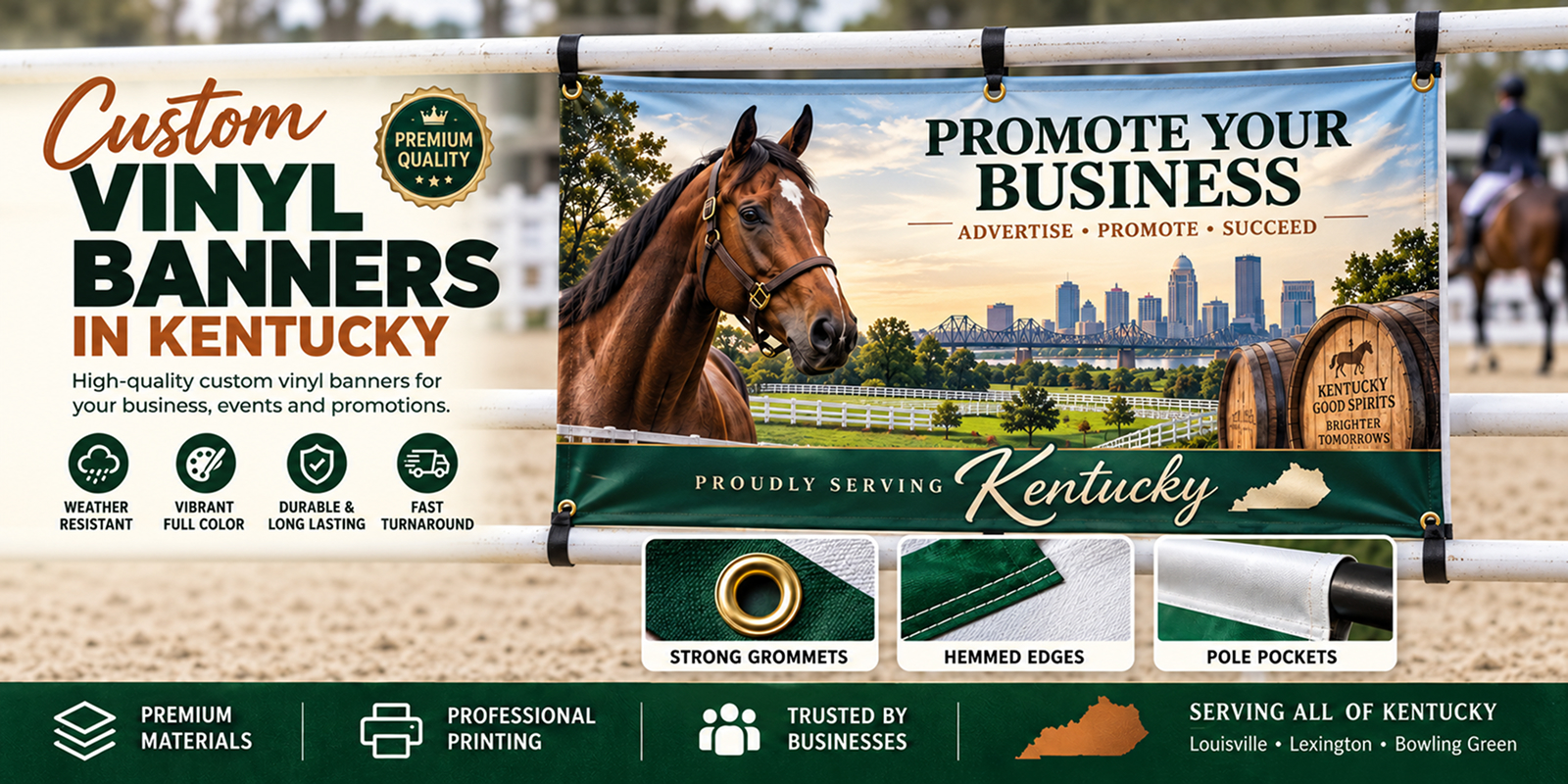
Retail and commercial advertising are obvious applications, but Kentucky buyers can use vinyl banners across a much wider range of settings.
The state has a strong calendar of fairs, festivals, sporting events, equestrian competitions, community gatherings, and business events. Kentucky's official highway resources also highlight fairs, festivals, performing arts activities, and equine competitions across the state, reflecting the variety of public events where temporary visual communication is useful.
For businesses, banners can support grand openings, seasonal campaigns, property promotions, sales announcements, and temporary identification. Event organizers can use them for sponsorship recognition, entrance branding, schedules, registration areas, and venue identification.
The important distinction is the purpose of the display. A promotional banner needs to encourage action. An entrance banner needs to establish recognition. A directional banner needs to reduce confusion. A sponsor display needs to give participating brands sufficient visibility. Treating every application as a standard advertisement can weaken the message.
Kentucky banner campaigns can span large cities, smaller communities, commercial districts, event venues, campuses, and private properties. That means the surroundings should be considered before the artwork is finalized.
Louisville, for example, has specific requirements for temporary banner signs placed on nonresidential premises. The city allows certain temporary banner signs subject to requirements covering permits, attachment, placement, size, and display duration. Additional requirements can apply in preservation districts, design overlay areas, and public rights-of-way.
That does not mean every Kentucky banner requires the same approval process. Rules can depend on the property, municipality, location, and purpose of the display.
For buyers, the practical step is simple: confirm the placement requirements before production when a banner will be displayed in a regulated area. This is particularly relevant for commercial properties, historic districts, public spaces, and installations associated with roads or public infrastructure.
A banner may be seen by someone standing directly in front of it, someone approaching an entrance, or someone passing at a distance. Those viewing situations affect how much information the graphic can realistically communicate.
Start with the information that absolutely needs to be noticed. The main message should have enough visual prominence to establish the purpose quickly. Secondary information can then support that message without competing with it.
For example, an event banner may need the event name and date to dominate. A retail promotion may prioritize the offer. A company banner may place greater emphasis on brand recognition. Directional signage needs especially concise wording because the viewer may have only a moment to process it. Large areas of empty space are not necessarily wasted space. They can help important lettering, logos, and graphics remain visually distinct.
Event signage rarely exists in isolation. A venue may contain sponsor displays, entrance graphics, directional signs, stage branding, registration signage, vendor identification, and promotional material at the same time.
This matters at Kentucky fairs, festivals, sporting events, equestrian gatherings, business conferences, and community programs where several organizations may share the same venue. Instead of filling every banner with the maximum amount of information, organizers can assign a specific communication role to each display. One graphic can establish the event identity, another can recognize sponsors, and another can help attendees navigate the venue. This creates a more organized signage system without requiring every banner to carry the same content.
Businesses operating in Kentucky can use custom vinyl banners to support temporary promotions as well as broader brand visibility.
A Louisville retailer may need signage for a storefront campaign. A Lexington business connected with the equestrian industry may need event-focused promotional graphics. A company serving customers across the Bluegrass region may use banners at trade events or community programs.
The graphic should reflect the audience seeing it. Local references can help when they are genuinely relevant, but adding city names simply for search visibility does not improve a physical banner.
For a statewide campaign, it can make sense to maintain a consistent visual identity while changing location-specific details on individual graphics. This is particularly useful when the same campaign appears at several venues.
The physical dimensions should be established alongside the intended viewing position rather than selected independently.
A narrow banner can work well across an entrance or along a railing where horizontal space is limited. A larger graphic may be appropriate for a building frontage, event perimeter, stage area, or spacious outdoor installation.
Printing Limitless supports standard banner sizes as well as custom dimensions. Custom sizing becomes useful when the available display area has unusual proportions or when the banner needs to align with an existing structure.
The finished size has a tolerance of approximately 0.5 inches. Large banners requiring sections are planned during production so the completed graphic can be assembled appropriately.
Outdoor exposure introduces considerations that do not apply in the same way to an indoor event display.
Wind movement, attachment points, surrounding structures, surface contact, and accessibility can all influence how a banner should be installed. A banner positioned in an exposed area may need airflow consideration, while one attached against a solid surface has a different installation environment.
Wind flaps can help reduce pressure by allowing air to pass through selected areas of the material. They can be useful for outdoor installations where wind exposure is expected.
Lamination is another consideration when the printed surface is likely to encounter repeated weather exposure, abrasion, or everyday handling. It adds a protective layer over the printed surface and can be selected when the application justifies it.
These decisions are best made according to the actual installation conditions rather than automatically adding every available option.
Kentucky's association with equestrian activities gives event organizers, businesses, sponsors, and venues a distinctive environment for banner use. The state highway map specifically identifies equine competitions alongside fairs, festivals, and performing arts activities.
Graphics used around sporting and equestrian events need to remain recognizable within busy visual surroundings. Sponsor logos, event branding, competition names, dates, and venue information may all appear within the same environment.
A clear hierarchy becomes particularly valuable when several sponsors or organizations share a display. Logos should have sufficient space to remain identifiable, while the main event information should retain visual priority.
For recurring competitions or annual events, a consistent design system can also help establish recognition across future editions.
A banner can meet production requirements and still require approval at a particular venue.
The Kentucky Fair and Exposition Center, for example, has rules governing commercial activity and the posting or display of commercial signs and printed material. Specific requirements can also apply during events such as the Kentucky State Fair.
Venue policies are separate from the banner's physical specifications. Before ordering a large quantity, organizers should check the location's exhibitor or event rules so the planned display is permitted.
This is especially useful for banners intended for convention centers, fairgrounds, sporting facilities, rented venues, and managed event spaces.
Roadside visibility can make banners attractive for events, promotions, and public announcements, but public rights-of-way are subject to specific controls.
Kentucky transportation rules include provisions for temporary banner use associated with qualifying fairs, parades, festivals, and similar public or charitable activities. Requirements can cover the location, installation, timing, ownership of supporting structures, and visibility near controlled access highways.
Private property displays should not automatically be treated like public right-of-way installations. Buyers should identify exactly where the banner will sit and confirm applicable local requirements before arranging installation.
A simple location check early in the project can prevent a finished banner from being unsuitable for its intended placement.
A digital design can look balanced on a monitor and become difficult to read once it is converted into a large physical banner.
Keep important wording away from edges and attachment areas. Logos need sufficient breathing room, while small text should be evaluated according to the distance at which viewers are expected to read it.
Images should have adequate resolution for the selected finished dimensions. Printing Limitless accepts common artwork formats including JPG, JPEG, PNG, GIF, WEBP, PDF, CDR, SVG, AI, EPS, TIFF, and PSD, with files up to 500 MB.
Customers who are still preparing their artwork can upload it later after placing an order. Professional design assistance is also available when the graphic requires additional creative support.
Color consistency becomes relevant when a company is producing banners alongside other branded materials.
A specific corporate color may need to remain consistent across event signage, promotional displays, trade show graphics, and physical marketing material. Printing Limitless offers Pantone color specification as an available option for projects where precise brand color matching matters.
This can be particularly useful for businesses attending several Kentucky events during the year, where the banner should remain visually consistent with existing brand assets.
Printing Limitless produces vinyl banners for Kentucky customers with production choices suited to indoor and outdoor displays. The available PVC Flex materials include 13 oz and Superior 16 oz options, while printing can be configured for single-sided or double-sided applications.
Custom dimensions are available alongside standard sizes. Finishing choices include metal grommets, strong adhesive grommets, and pole pocket configurations, with wind-related options available for selected outdoor applications.
Customers can also use design proofing, professional design assistance, Pantone color specification, and bulk order pricing when those options fit the project.
Free shipping and door-to-door delivery are available for orders shipped across Kentucky.
A successful banner order starts with a few practical details: the display location, approximate viewing distance, available space, expected exposure, installation method, artwork status, and required quantity.
Having those details ready makes it easier to select the appropriate configuration without adding unnecessary specifications. It also gives the production team useful information when a project involves unusual dimensions, multiple graphics, or a larger event campaign.
For Kentucky projects involving regulated locations or managed venues, approval should be confirmed before production begins. For standard private property applications, the focus can remain on getting the dimensions, artwork, installation requirements, and quantity right.
Printing Limitless can support the production side of that process, including custom sizing, artwork preparation, design proofing, and delivery across Kentucky.