Free Shipping on Orders $99+
Use Code FLAT15 & Get 15% Off On All Orders
Choose your store
Prices, currency, and delivery follow the store you select.
Prices, currency, and delivery follow the store you select.
Maine has a way of turning a simple banner into part of the landscape. A sign outside a working waterfront business in Rockland has to compete with boats, docks, weathered buildings, and changing tides. A banner near Bar Harbor is seen by visitors moving between shops, restaurants, lodging properties, and Acadia National Park, while a farm sign in rural Maine might sit beside a road where people are driving past at very different speeds.
That makes custom vinyl banners in Maine less about filling a predetermined rectangle and more about making the message work within a distinctly Maine setting. Coastal exposure, seasonal tourism, agricultural fairs, maritime events, foliage, and long winter downtime can all influence how a banner is used and where it is installed.
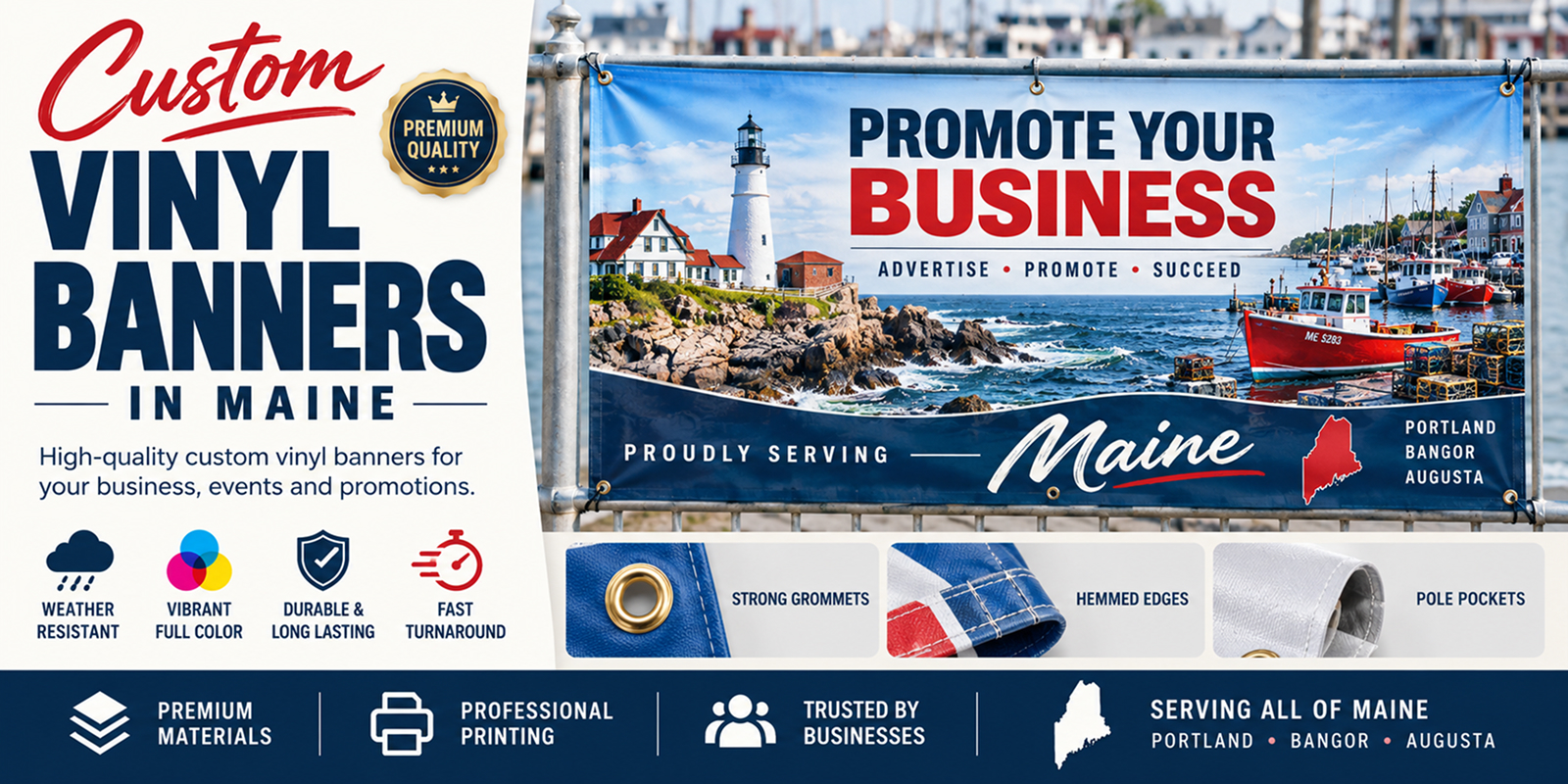
Maine's coast is closely tied to commercial activity. Fishing, lobster, boating, tourism, restaurants, galleries, marinas, and waterfront retail all operate in places where salt air, wind, changing weather, and pedestrian traffic overlap.
A banner beside a harbor therefore has a different visual environment than one displayed inside a conference room in Portland. The background can be busy, the viewing distance can change throughout the day, and the banner may be exposed to weather while still needing to look professional for customers arriving on foot.
This is particularly relevant for outdoor vinyl banners in Maine. The banner has to remain readable without competing with every visual element around it.
For a waterfront setting, the most important information might be the business name, a tour departure point, a seasonal offer, or an event name. A banner covered with secondary details can disappear visually even when the print itself is clear.
The Maine coast is not simply a scenic backdrop. It is a working environment where businesses regularly deal with wind, moisture, and salt exposure.
A banner mounted near the water can also be exposed to conditions that are different from a sheltered storefront a few blocks inland. That does not mean every coastal banner requires the same specification, but it does make the installation location important when deciding how the banner will be mounted and how long it will remain outside.
Printing Limitless offers 13 oz and 16 oz PVC Flex options, giving customers two material weights for different applications. The 16 oz option provides a heavier material with increased strength and UV resistance.
For a seasonal waterfront business, this can become particularly relevant when the same banner is expected to remain outdoors throughout a busy operating period rather than being used for a single afternoon.
Portland combines restaurants, independent businesses, galleries, offices, hospitality, festivals, markets, and a busy downtown environment. Signage here often has to work at pedestrian scale rather than simply being visible from a long distance. That changes the design priority.
A restaurant banner on a commercial street does not need a paragraph explaining the business. A short seasonal offer or event message can be enough when the storefront itself supplies the rest of the context. An arts organization might prioritize event identity and dates, while a market vendor may need a clear business name that visitors can recognize from several booths away.
This is where custom banner printing in Maine can be useful. A banner can be sized around the actual storefront, event structure, fence, or display area instead of forcing the business to adapt its space around a standard sign.
Bar Harbor sits beside one of Maine's most recognizable visitor destinations. Acadia National Park recorded approximately 4.08 million recreation visits in 2025, placing it among the ten most visited national parks in the United States that year. The National Park Service describes the park as protecting Atlantic coastal headlands and providing extensive motor roads, hiking trails, and carriage roads. That visitor activity creates a very particular commercial environment around Mount Desert Island.
Restaurants, tour operators, lodging businesses, galleries, outdoor recreation companies, and local retailers can have audiences who are unfamiliar with the area. A banner may therefore need to communicate information that a local customer would already understand.
Directional clarity becomes especially useful. If the banner is identifying a business, activity, pickup point, entrance, or special promotion, the message needs to register quickly with visitors who have no previous familiarity with the location.
A custom vinyl banner in Maine can support that type of temporary or seasonal communication without requiring the business to redesign its permanent storefront signage.
Maine's event calendar is closely connected to its coastal identity. The official Visit Maine calendar includes food festivals, cultural events, agricultural fairs, outdoor activities, and community celebrations across the state.
The Maine Lobster Festival in Rockland provides a particularly useful example. The 2026 festival included food, entertainment, competitions, arts and crafts, maritime programming, vendors, and a large parade through downtown Rockland. The festival's organizers reported that the event welcomed visitors from all 50 states and more than 20 countries in 2026.
A festival environment creates several distinct banner requirements:
| Festival area | Banner purpose |
|---|---|
| Vendor space | Business or product identification |
| Sponsor area | Brand recognition |
| Entrance | Event identification |
| Information point | Visitor directions |
| Food area | Vendor identification and promotion |
| Activity area | Program or attraction identification |
| Parade route | Community or sponsor visibility |
The key difference is that festival visitors are constantly moving. A banner competing with dozens of booths, signs, tents, people, and displays needs a strong visual hierarchy rather than an information-heavy layout.
Maine's fairs are not simply entertainment events. They reflect the state's agricultural and rural traditions, with exhibitions, livestock, crafts, food, machinery, competitions, and community programming.
Visit Maine describes the state's agricultural fairs as multi-day events featuring livestock shows, agricultural and craft exhibits, mechanical pulls, harness racing, live music, rides, and other attractions.
Fryeburg Fair illustrates the scale these events can reach. Visit Maine describes it as Maine's largest and most popular autumn agricultural fair, with attendance reaching upwards of 300,000 people annually.
For exhibitors and vendors, the banner helps people identify who is behind a booth, exhibit, product, or sponsorship.
That means a banner designed for an agricultural fair does not necessarily need the same visual treatment as a polished
corporate display. Strong branding, a recognizable business name, and a clear product or service message can be more useful than excessive decorative detail.
The farther east a business operates, the more seasonal and community-oriented some local events can become. The Machias Wild Blueberry Festival is a good example.
The 2026 festival marked its 50th anniversary and ran August 14 – 16, with craft booths, food vendors, fresh blueberries, entertainment, contests, and other activities. The official vendor information lists 10 × 10 ft vendor spaces across several festival areas.
That creates a useful distinction for custom vinyl banner printing in Maine. The banner does not always have to be designed for a massive commercial venue. A smaller vendor may need a compact sign that identifies the business clearly within a defined booth footprint.
A good vendor banner can establish the brand before a visitor reaches the table. It can also make the booth easier to find again when an event covers several streets, lots, or activity areas.
Wild blueberries are closely associated with Downeast Maine, and the Machias festival specifically celebrates that regional heritage. The event's official material describes the festival as a celebration of the wild blueberry tradition that has helped put the region on the map.
For farms, food businesses, producers, craft sellers, and community events, that creates opportunities for highly specific banner messaging. Instead of relying on generic promotional language, the artwork can emphasize the product, location, event name, or local identity that makes the business relevant to visitors.
That approach works especially well when the surrounding setting already tells part of the story. A farmstand does not need a banner explaining every product it sells if the sign can quickly communicate the farm name, featured product, and reason to stop.
Maine's tourism economy has a pronounced seasonal component. Coastal communities become significantly busier during warmer months, foliage creates another visitor period, and winter changes the customer mix in northern and inland communities. That makes timing an important part of banner planning.
A banner promoting a summer harbor activity can be designed around a short operating season. A farm sign can focus on harvest season. A ski or winter recreation business needs a message that remains useful during colder months. An annual festival can use recurring branding while changing dates or sponsor information each year.
For businesses that remove banners after a campaign, proper storage becomes part of the product's useful life. Printing Limitless recommends cleaning vinyl with a soft, damp cloth and avoiding cleaning agents before storage.
The banner should be completely dry before it is folded and stored. This is particularly relevant in Maine, where a banner used around coastal or outdoor events can accumulate moisture before it is taken down.
Maine's fall scenery is a marketing advantage for many businesses, but it can also become a visual challenge.
A banner surrounded by red, orange, yellow, and green foliage can disappear if its artwork uses the same colors without enough contrast. A business promoting a fall attraction, farmstand, foliage tour, restaurant, or seasonal event needs the message to remain distinct from the landscape behind it.
The solution is not necessarily to use louder colors. Strong contrast, restrained backgrounds, and a clearly separated headline can make the information easier to recognize. This is especially important for roadside locations where viewers have only a few seconds to process the sign.
Printing Limitless provides standard sizes alongside custom dimensions, allowing the banner to be configured around a particular storefront, event structure, booth, fence, wall, or other display area.
Current standard options include:
| Width | Height |
|---|---|
| 3 ft | 2 ft |
| 2 ft | 3 ft |
| 3 ft | 4 ft |
| 4 ft | 3 ft |
| 3 ft | 6 ft |
| 6 ft | 3 ft |
The product specification lists a size tolerance of ±0.5 inches. Banners exceeding 10 feet in either height or width are produced in multiple sections and joined together.
For Maine businesses, the available space can be particularly irregular. A harbor-side property may have a narrow fence section. A festival booth has defined dimensions. A farmstand may have a wall, roadside frame, or entrance structure that determines the available proportions.
Measuring that space first helps keep the banner proportionate and prevents important design elements from being forced into an awkward layout.
Printing Limitless offers several finishing configurations, with the added costs you provided:
| Option | Added cost | Best for |
|---|---|---|
| No grommets | Included | Banners going into a frame or track system |
| Metal grommets | Included | Standard fence, wall, or frame mounting |
| Pole pocket, top only | +$0.70 | Simple pole hanging setups |
| Pole pockets, top and bottom | +$1.40 | Secure vertical pole mounting |
| Pole pockets, left and right | +$1.40 | Horizontal pole or fence line mounting |
| Strong adhesive grommets | +$4.99 | Surfaces where drilling or punching is not possible |
| Wind flaps | +$9.99 | Open, windy sites where airflow needs to pass through |
For a waterfront or exposed outdoor display, the mounting structure deserves attention before the banner is ordered. The hardware needs to work with the surface and allow the banner to remain properly secured without creating unnecessary stress around the attachment points.
Wind flaps can be useful when the display is exposed to moving air because the openings allow airflow through the banner. They are particularly relevant for open waterfront spaces, exposed festival grounds, and other locations where wind is a regular part of the environment.
Maine's fairs, markets, waterfront events, and pedestrian areas often create situations where visitors can approach a display from different directions. A freestanding vendor banner can therefore have a different requirement than a banner mounted flat against a building.
Single-sided printing is generally appropriate when only the front face needs to communicate. Double-sided printing can make more sense when the banner is visible from both directions, such as an open market aisle, entrance, walkway, or freestanding event display. Printing Limitless offers both configurations, allowing the print setup to match the way people move around the display.
Maine's natural surroundings are visually distinctive, which makes restraint useful in banner design.
A lobster business does not need to fill every available area with nautical graphics. A farm does not need a complete illustrated landscape behind its name. A tourism business can communicate its identity without turning the banner into a collage of local scenery.
The strongest designs usually establish a clear hierarchy:
For established businesses, Pantone color specification can also be used when maintaining closer brand color consistency is important.
Maine has specific state rules governing signs placed within public rights-of-way and along highways. Current Maine law allows certain temporary signs in the public right-of-way for up to 12 weeks per calendar year, divided into a maximum of six-week periods in the first and second halves of the year, subject to conditions including size, spacing, and identification requirements.
The law also limits such temporary signs to 4 ft × 8 ft and requires identifying information on qualifying signs.
There are additional restrictions and exceptions depending on the road and sign category. MaineDOT also operates an Official Business Directional Signs program for eligible businesses such as gas, food, lodging, camping, and attraction services.
That does not mean every banner ordered for a Maine business falls under the same rules. A banner on private property, a temporary event display, and a sign within a public right-of-way can have different requirements.
Before installing a banner, confirm the applicable state and municipal rules for the exact location. This is especially important when the display will be placed near a highway, within a public right-of-way, or across a public way.
Maine's commercial landscape gives banners several practical applications beyond standard retail promotions.
| Setting | Banner use |
|---|---|
| Lobster or seafood business | Seasonal promotion, business identification |
| Marina or boat tour operator | Departure information, tour promotion |
| Restaurant or brewery | Event promotion, seasonal messaging |
| Farmstand | Product identification, harvest promotion |
| Craft vendor | Booth branding and business identification |
| Agricultural fair | Exhibitor, sponsor or activity signage |
| Tourism business | Activity promotion, entrance identification |
| Hotel or lodging property | Event and seasonal promotions |
| Outdoor recreation company | Tour, rental or activity information |
| Community festival | Entrance, sponsor and directional signage |
| Retail storefront | Opening, sale or seasonal campaign |
| School or civic group | Event and community announcements |
The value of the banner changes according to the setting. A vendor needs recognition within a crowded event, while a roadside business needs quick readability, and a tourism company may need a clear call to action for visitors unfamiliar with the area.
Printing Limitless gives customers the flexibility to configure a banner around the physical setting, intended use, and display method.
Available options include:
That range can support a compact vendor banner for a Maine agricultural festival, a branded display for a waterfront business, a seasonal promotion for a farm, or a larger event banner intended for a busy visitor area.
The important part is configuring the banner around its actual use instead of treating every Maine installation as the same type of signage.
Start with the physical location and the people who will see the banner.
Measure the usable space and note nearby structures that could affect visibility.
Decide how long the banner needs to remain relevant and exposed.
Choose a standard size or specify custom measurements.
Select 13 oz or 16 oz PVC Flex according to the application.
Choose single-sided or double-sided printing based on how visitors approach the display.
Select the attachment option that works with the existing structure.
Upload finished artwork or use the available design assistance.
Confirm applicable Maine and municipal sign rules before outdoor installation.
A harbor business in Rockland, a farmstand in rural Maine, a vendor at Fryeburg Fair, or a tourism business near Bar Harbor can all require different banner specifications even though they are ordering the same basic product.
Maine businesses operate in an environment where local commerce, seasonal tourism, agriculture, maritime industries, outdoor recreation, and community events overlap. That gives physical signage a role that changes with the place and time of year.
A custom vinyl banner in Maine should therefore do more than occupy available space. It should make the business, event, product, or message recognizable within the setting where people will encounter it.
Printing Limitless provides custom vinyl banners in Maine with flexible dimensions, PVC Flex material choices, full color printing, multiple finishing configurations, and design support.
Use the physical location, seasonal purpose, audience, and installation conditions to determine the banner configuration, then keep the message clear enough to work in the real Maine setting where it will be seen.