Free Shipping on Orders $99+
Use Code FLAT15 & Get 15% Off On All Orders
Choose your store
Prices, currency, and delivery follow the store you select.
Prices, currency, and delivery follow the store you select.
Oregon is a state where a banner can move between very different environments. A business district in Portland, a community event in Eugene, a trade gathering in Salem, a seasonal promotion in Bend, or an outdoor activity near Medford can all require temporary visual communication, yet the surroundings and audience can be completely different.
That makes the planning stage important. The banner needs to communicate quickly, suit its surroundings, and remain practical for the conditions in which it will be displayed.
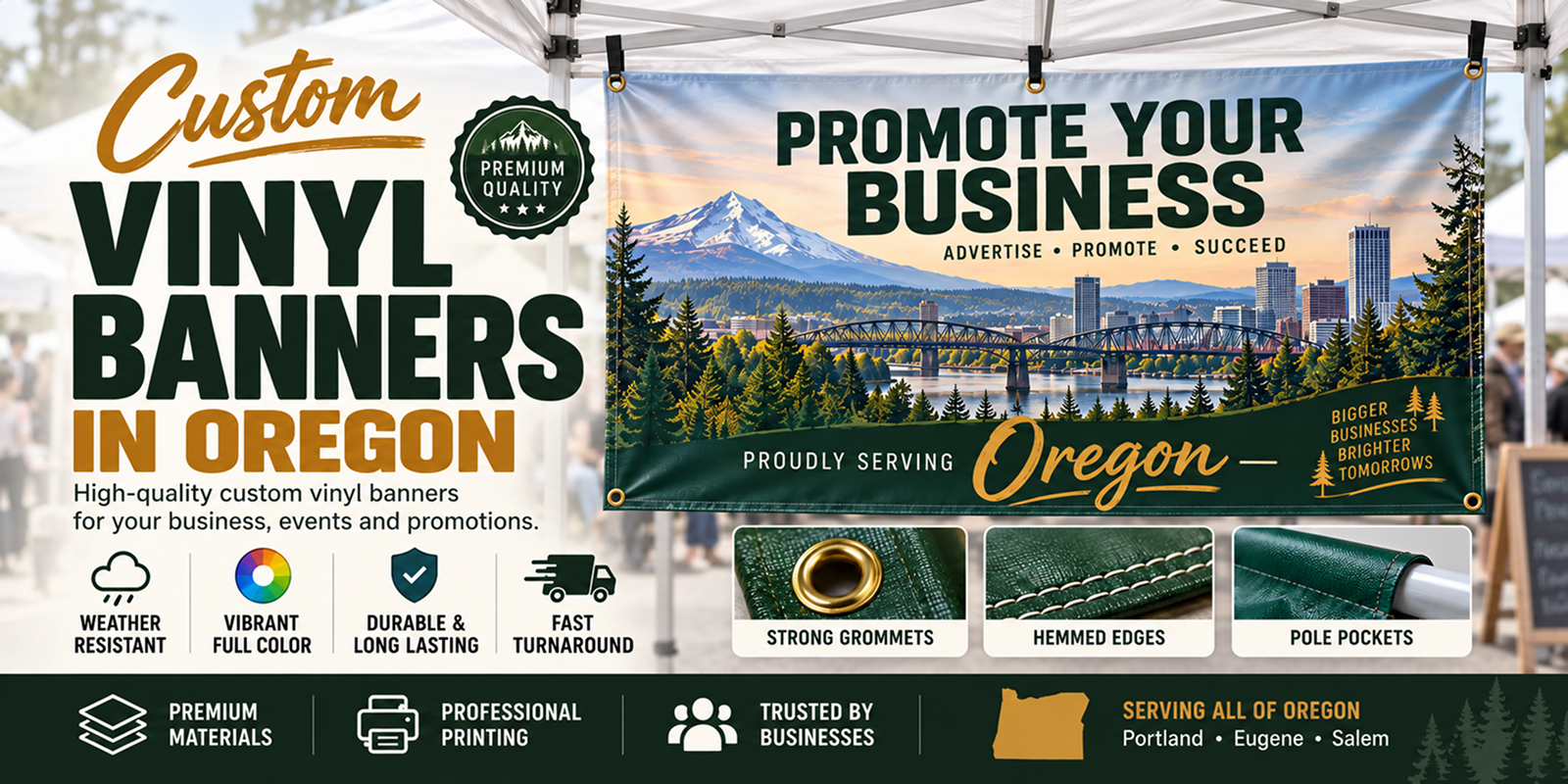
Custom vinyl banners in Oregon can support retail promotions, company branding, event signage, sponsorship displays, construction notices, school activities, community programs, and outdoor advertising. Printing Limitless offers custom banner production with options for sizing, material, printing, finishing, artwork preparation, and delivery across Oregon.
Before choosing dimensions or preparing artwork, identify the actual job of the banner.
A promotional banner needs to attract attention and communicate an offer. An event banner may need to establish the event identity. A directional graphic needs to make navigation easier. A sponsorship banner has to give participating organizations enough visual presence without overwhelming the main event message.
That distinction changes the design.
| Banner purpose | Information that usually deserves priority |
|---|---|
| Retail promotion | Offer, product, brand, call to action |
| Event identification | Event name, date, location |
| Directional signage | Destination, instruction, arrow |
| Sponsorship | Event identity, sponsor logos |
| Business branding | Company name, logo, core message |
| Construction or property display | Project information, contact details |
| Community announcement | Main announcement, date, supporting information |
Ask a simple question: Where will someone be standing when they see this banner?
That question is often more useful than starting with a standard banner size.
A graphic viewed beside a storefront can carry considerably more detail than one intended for people moving past an outdoor event area. A banner placed above an entrance may need large lettering that remains readable at ground level. A sponsor graphic positioned around a field or arena may need strong logos that can be recognized across a larger viewing area.
The design should therefore be built around the expected viewing distance.
Large lettering, strong contrast, generous spacing, and a clear visual priority help the message survive real-world viewing conditions. Small details can still be included, but they should not compete with the information that needs immediate attention.
There is a temptation to use every available inch once a large banner has been ordered. That can produce the opposite result. A strong banner gives the eye somewhere to begin.
Use one dominant message, support it with secondary information, and give important graphics enough breathing room. Logos should remain recognizable rather than being squeezed between several lines of text. Contact information should be large enough to serve its purpose.
A useful design test is to step away from the screen before approving the artwork. If the main message disappears as soon as the graphic is viewed at a distance, the layout needs another pass.
Anything that does not support one of those three stages deserves another look.
Events create an interesting banner challenge because the viewer is rarely standing still in front of the graphic.
People may be walking toward registration, looking for an entrance, moving between vendors, waiting near a stage, or scanning sponsor displays. That makes short, highly visible messages especially useful.
Oregon's event landscape includes fairs, markets, festivals, sporting activities, cultural programs, business gatherings, school events, and community celebrations. The same banner strategy will not work equally well across all of them.
Instead of giving every banner the same role, organizers can divide communication across the venue.
This approach can make a large event easier to navigate without turning every banner into a crowded information board.
Ordering several banners does not mean every graphic needs identical artwork.
A campaign can use a common visual identity while giving each banner a separate purpose. This works particularly well for conferences, festivals, retail promotions, school programs, and multi-location business campaigns.
For example, an event could use one large identification banner, several sponsor graphics, and a series of directional displays. The branding can remain consistent while the actual message changes according to location.
This also makes the artwork easier to organize. Each graphic has a defined role instead of becoming another copy of the same design.
Oregon's outdoor environments can vary significantly across the state. Coastal locations, inland communities, urban areas, mountain regions, and open event grounds can expose a banner to different conditions. The placement itself matters.
A banner secured against a building is experiencing a different environment than one positioned in an exposed event area. An installation surrounded by structures may receive some protection, while an open site can experience stronger air movement.
Wind flaps can help selected outdoor banners release some air pressure. Lamination can add protection where the printed surface is expected to experience weather exposure, abrasion, or repeated handling.
These options should support the installation rather than become automatic additions to every order.
Weather planning often gets reduced to a simple question about rain. Outdoor banner performance involves a wider set of conditions.
Consider:
A banner used for a short event can have different requirements than one expected to remain outdoors for an extended campaign.
The installation location should therefore be discussed alongside the expected use period when selecting the production configuration.
Some Oregon installations place the graphic where people can approach it in multiple directions.
A banner positioned across an open event area, along a pedestrian route, or in a location where viewers can reach either face may benefit differently than one attached directly against a wall.
Printing Limitless supports single-sided and double-sided banner production. Double-sided printing can accommodate two faces when the display needs communication in opposing viewing directions.
The artwork should be planned around that requirement before production. If the two faces need separate messages, each side can be prepared as its own graphic rather than treating the banner as one image repeated automatically.
Vinyl banners are often associated with sales and events, but their usefulness extends into everyday business communication.
They can help identify a new location, communicate a temporary service change, promote a property, announce a new offering, or reinforce company branding at a business event.
For a business operating across several Oregon markets, the banner can also become part of a broader physical marketing system. Core branding can remain consistent while individual graphics reflect a local promotion, event, or location.
That approach is useful when the business needs physical signage without creating a completely new visual identity for every campaign.
The banner itself is only one part of an installation.
A venue may have its own requirements concerning advertising, attachment methods, display locations, approved materials, installation schedules, or sponsor visibility. This can apply to convention facilities, fairgrounds, sporting venues, campuses, private event properties, and managed public spaces.
Confirming those requirements before production is particularly useful when several banners are being ordered for one event. The question is not simply, "Can this banner be produced?" It is also, "Can this banner be displayed here in the planned manner?"
Oregon does not have one universal rule that automatically applies to every banner installation. Local sign regulations can differ.
Portland provides a useful example. Temporary banners on private property are subject to city registration requirements in many cases. Banners 32 square feet or smaller can fall within specific exemptions, while larger banners and certain additional banner installations can require registration. Temporary banner registrations also have defined display periods.
Cross street banners and banners attached to city-owned streetlight poles have separate requirements. Portland's cross street banner program is intended for qualifying public events, including neighborhood and charitable activities, and applications need advance planning.
This is why Oregon buyers should confirm the rules associated with the actual installation location instead of assuming that a banner permitted in one setting will automatically be acceptable elsewhere.
A banner placed on private property should not be treated the same way as one extending into a public street area.
Roadside locations, utility structures, streetlight poles, and cross street installations can involve additional permissions. Oregon also maintains state-level policies governing official highway signs and related sign activity.
For a banner intended near a road, identify the property boundary and installation structure before ordering. That small step can determine which rules need attention.
Not every banner location has convenient proportions. A narrow storefront frontage, long fence section, event entrance, stage backdrop area, or building facade may require a dimension that does not match a standard product size.
Printing Limitless offers custom banner sizing in addition to standard dimensions. This gives Oregon buyers greater flexibility when the display area has a specific width or height requirement.
The best size is the one that fits the physical space while preserving a readable design. Increasing the dimensions simply to create a larger graphic does not necessarily improve communication.
Printing Limitless offers Elite PVC Flex in 13 oz and Superior 16 oz options.
The 13 oz material uses 720 DPI eco-solvent printing, while the Superior 16 oz option uses 600 DPI UV printing. Both provide options for custom vinyl banner applications, allowing the production choice to be considered alongside the intended environment.
For buyers, the useful question is not simply which material sounds heavier or newer. Consider the expected exposure, physical handling, display setting, and desired production characteristics before making the selection.
The mounting method can influence which finishing configuration makes sense.
Printing Limitless offers metal grommets, strong adhesive grommets, and pole pocket configurations. Pole pockets can be positioned along selected edges according to the installation requirement.
Wind-related options are also available for outdoor applications where airflow needs additional consideration.
The mounting plan should be established before the artwork reaches its final stage. That gives the design enough room around attachment areas and reduces the chance of important graphics being placed too close to the edges.
A banner may be part of a much larger brand presentation.
A company exhibiting at a business event may need its banner to sit alongside printed displays, promotional materials, booth graphics, and digital branding. A retailer may want its physical signage to maintain the same recognizable colors used across its storefront and marketing.
Printing Limitless offers Pantone color specification for projects where a particular brand color needs closer control. This option becomes especially useful when color consistency has a direct role in brand recognition.
Not every banner project begins with a final design file. Printing Limitless allows artwork to be uploaded later after an order has been placed. Customers can also use professional design assistance when the graphic needs creative preparation.
Supported artwork formats include JPG, JPEG, PNG, GIF, WEBP, PDF, CDR, SVG, AI, EPS, TIFF, and PSD. Files can be up to 500 MB. A design proof can also allow customers to review the prepared artwork before production.
That makes the ordering process useful for projects where the physical requirements are already known, but the final creative file is still being completed.
Large banners can involve additional production considerations, especially when the finished dimensions exceed normal material widths.
Printing Limitless can produce oversized banners in multiple sections when necessary and join those sections during production. This allows a large graphic to be planned around production limitations rather than forcing the design into an unsuitable smaller format.
For event organizers, property managers, and businesses ordering several large graphics, it helps to provide the final display dimensions early in the process.
A single banner is a straightforward purchase. A campaign involving several graphics requires greater coordination.
Multiple banners may need different dimensions, separate artwork files, varied messages, or identical branding across the set. Preparing the order as a group can make those requirements easier to organize.
Bulk order discounts are available for qualifying quantities, which can be useful for event campaigns, business signage programs, sponsorship packages, or larger promotional projects.
The important part is keeping each graphic clearly identified during artwork preparation so the correct design reaches the correct physical banner.
Vinyl banners are designed to be practical, but simple care still matters.
For cleaning, use a soft, damp cloth and avoid cleaning agents that may affect the printed surface. When a banner is removed temporarily, storing it carefully can reduce unnecessary creasing, abrasion, or damage.
If the banner will be reused, keep the material clean and dry before storage. The same basic care becomes particularly useful for event graphics that will be installed several times during a season.
By the time the artwork is ready, there are usually a few practical details left to settle: the final dimensions, quantity, display requirements, artwork format, and delivery schedule. Printing Limitless brings those pieces together in one ordering process, so customers can move ahead without coordinating separate design, printing, and delivery arrangements.
Need a banner for a single storefront promotion? Planning signage for an Oregon event with several graphics? Preparing a larger display with specific dimensions? The same ordering process can accommodate individual projects as well as larger banner requirements.
Customers can supply their own artwork, upload it later, or request professional design assistance when the creative work still needs attention. Design proofing is available before production, giving the customer a chance to review the prepared graphic.
With free shipping and door-to-door delivery available across Oregon, the finished banners can be sent directly to the required address. That can be particularly convenient when the display is being prepared for an event venue, business location, school, organization, or campaign site.
A few details are worth having ready:
| Detail | Why it matters |
|---|---|
| Display location | Helps establish the physical environment |
| Finished dimensions | Determines the appropriate production setup |
| Viewing distance | Influences text and graphic scale |
| Indoor or outdoor use | Helps establish exposure considerations |
| Installation method | Determines suitable finishing |
| Number of banners | Helps organize artwork and quantity pricing |
| Artwork status | Establishes whether design assistance is needed |
| Display rules | Confirms venue or local requirements |
Once these details are clear, the rest of the order becomes much easier to organize.