
How to Secure a Canopy Tent in Wind: Anchoring Methods for Different Surfaces
All it takes is a sudden gust of wind to put a damper on an otherwise perfect arrangement for the event. The canopy tent that had been stable a few moments ago would become unstable, move, and lift from its sides. In using a custom canopy tent at events like trade shows and outdoor markets, stability is as vital as appearance.
The problem is that a heavy-duty canopy tent is not necessarily windproof. There are many elements contributing to its stability, including the type of surface under the tent, its fixation, and the weather conditions at the site of the event. While a certain strategy of fixing a customized pop-up canopy tent might work well on a grassy field, it could be totally ineffective on an asphalt or sand surface.
The use of the right canopy tent anchors can mean a world of difference to your outdoor experience, but choosing the right method may not be easy.
- How much weight would suffice?
- Should you opt for conventional stakes?
- Is there another anchoring technique that could work better on solid ground?
- What is the signal that the weather conditions have made your arrangement hazardous?
Why Canopy Tents Move or Lift in Wind
Wind affects a canopy in many ways. Signs of instability do not have to be very evident at all times. Wind not only pushes the canopy from a specific direction; it lifts the canopy, gets trapped in areas of high air pressure, and exerts pressure in an inconsistent manner. All this information is useful when deciding on which type of canopy tent anchoring to use before setting up your tent.
The Sail Effect (Aerodynamic Lift)
The wind blowing over the canopy roof can exert an upward pressure, just like the wind blowing against a sail. This pressure can lift the frame or move the feet around, particularly in situations where there is inadequate canopy tent weight for anchorage. A custom pop-up canopy tent may be very steady in quiet weather but becomes susceptible when the wind catches its roof.
The Funnel Effect (Trapped Air)
Air can get trapped under the canopy roof and cause pressure that lifts up the entire structure. The issue is enhanced further when the wind passes under the material and does not have much space to go out. Even so, the right canopy tent setup and anchoring can minimize the movement issue, but only to certain levels.
The Kite Effect (Sidewall Drag)
The sidewalls block the sun, yet they increase the area where the wind is working. The wind blowing against a closed sidewall will exert force that will either pull the canopy away or apply additional stress on its framework. For a custom printed canopy tent used during an outdoor marketing event, proper anchoring will be required. The removal of the sidewalls will decrease wind resistance; however, removing the canopy may also be required.
Inadequate Lower Ballast
The canopy can move or lean if its legs are not fixed with proper anchoring or weight. If you rely on the weight of the structure itself or use inadequate ballast, then it becomes susceptible to strong gusts. The right canopy tent wind protection requires proper anchoring of the canopy with the help of suitable canopy tent anchors as per the manufacturer’s guidelines. While grass can support stakes, concrete surfaces require special anchoring equipment.
Choosing the Correct Way to Anchor a Canopy Structure
According to the state of the ground below your canopy, wind speeds, and available points for anchoring the structure in the particular location, a different anchoring strategy can be employed. The most effective means of anchoring your outdoor canopy would be the one that can stabilize it without hurting the ground, canopy legs, or surrounding buildings.
Ground Stakes and Screw-In Anchors
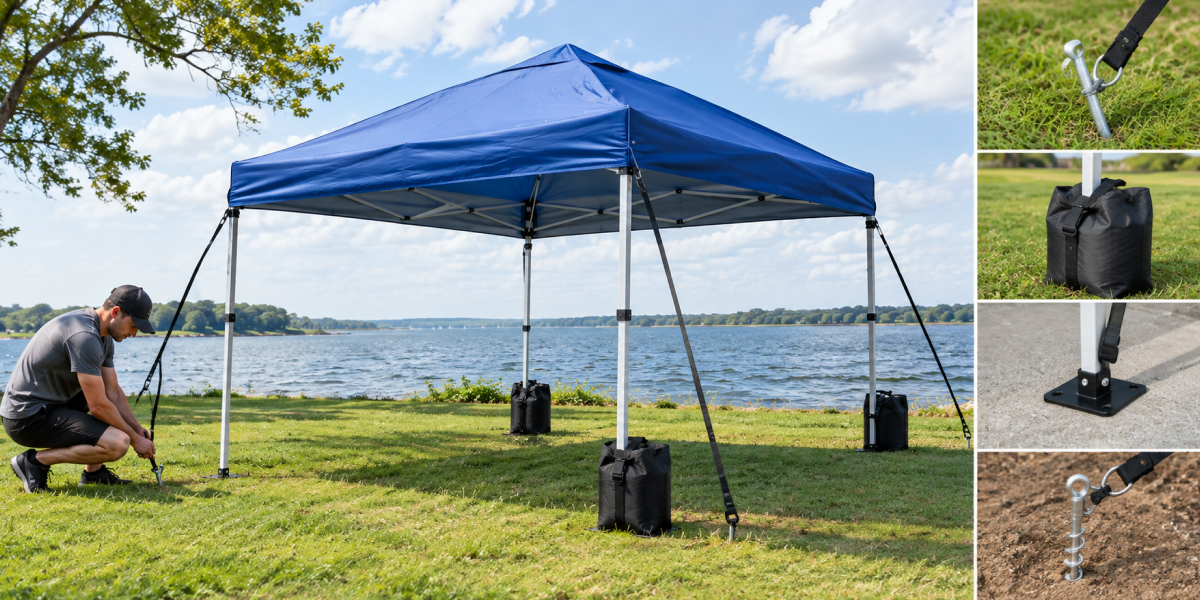
Ground stakes would be an effective alternative where there is grass and hard ground, in which case the stakes can penetrate into the ground to help secure the canopy legs. Other options, like heavy-duty tent stakes and canopy tent anchors that are screwed into the ground, could provide more effective holding capacity where applicable.
Sandbags and Canopy Weight Bags
Canopy sandbags can prove helpful if stakes cannot be installed on the surface. These are attached to the canopy legs and provide additional weight for restricting movement. Choose pop-up canopy weights that can fit properly on the frame. Make sure to use the proper amount of weight recommended by the manufacturer. It is important to ensure that the bags are well-filled and are placed in proper positions to prevent any slippage or leakage.
Water Weights and Weighted Footplates
Water weights can act as an anchor for outdoor activities. These can be filled at the location and then emptied prior to transportation, thus avoiding having to transport ballast that is quite heavy. The weighted footplates are yet another option, where mass can be added directly to the canopy feet. However, they must be appropriate for the frame and must be used in accordance with the manufacturer’s guidelines. Connections should be checked before and during the event if there is wind present.
Concrete Blocks and Other Ballast Options
Concrete blocks or custom-made ballast weights could also be used in places where additional ballast is needed, and such materials are allowed in the venue. This could prove helpful in ensuring that the heavy-duty canopy tent is properly anchored, but improvised ballast needs to be put in such a way that it does not cause damage to the frame, create tripping risks, or fall off. It is also important to make sure that each piece of ballast remains in its place by using appropriate attachments.
Remember that you can use the same anchoring strategy for every canopy size. A large tent catches a lot more wind than a 10x10. So, it is advisable to follow the product’s official guidelines.
Guy Lines, Tie-Down Straps, and Ratchet Straps
Guy lines and tie-down straps can add extra strength through attachment to ground anchors or fixed attachments. These reduce the amount of sway when used properly. Tents must never rely solely on the use of straps if the lower legs are not secured. Do not tie straps to anything flimsy, obstruct pathways, or pull them tight enough to bend the frame. Inspect the straps, anchors, and frame for damage. Take down the canopy if conditions surpass the specifications of operation.
How to Secure a Canopy Tent on Different Surfaces
The correct way to attach a canopy to the ground is based significantly on the kind of ground available as well as its ability to support the anchoring system. To avoid complications in the future, it is important to evaluate the ground before starting to set up the canopy.
How to Anchor a Canopy Tent on Grass and Soil
For firm soil, use heavy-duty tent stakes or screw anchors at their proper depths. Soft, moist, or newly turned soil will not properly anchor the pegs or anchors. Test each peg or anchor to make sure it is properly anchored. If the soil won’t hold, consider another method of anchoring.
How to Secure a Canopy Tent on Concrete
No traditional tent stakes are possible on concrete. Instead, use special weights tied securely to each canopy leg. It is important that the concrete tent anchoring follows all the venue requirements and that the weights are not able to move and block the walkways.
How to Anchor a Canopy Tent on Asphalt
Before you install canopy tent stakes, ensure that it is okay to penetrate the ground at the venue. Also, ensure that the asphalt will be able to hold the stakes well. If there is no option to penetrate the ground, or if the asphalt is not good enough, use appropriate ballasts.
How to Secure a Canopy Tent on Sand
Loose sand may result in the regular poles getting dislodged due to the stress applied to them. The anchoring should be done using special poles that are meant for sandy soil and should be done at the specified depths and angles. Canopy sandbags can add support, but one needs to monitor them for any movement.
How to Anchor a Canopy Tent on Gravel or Uneven Ground
Gravel can hinder the grip of the stakes, and an uneven surface can cause instability of the frame. Find the sturdiest and most level ground possible, and make sure that the anchor is compatible with the type of soil under the gravel layer. Make sure that all four legs are firmly planted; if they are not, find another place for the shelter.
How Much Weight Does a Canopy Tent Need in Wind?
The weight needed for securing a canopy is based on the size, design, the method of securing it, and the weather expected. It would be best to stick to the guidelines set by the manufacturer and not those set universally.
Factors That Affect Canopy Weight Requirements
Several factors influence the canopy tent weights needed for stability:
- Size of Canopy: Structures of larger size have more surface area subjected to wind pressure.
- Design of Frame: A lightweight frame might need extra support within certain manufacturer specifications.
- Wind Speed: Higher wind speed creates more pressure on the canopy.
- Ground Material: Anchoring will be done differently if the ground is concrete, grass, or sand.
- Sidewalls: Side walls may trap wind and cause more lateral pressure on the canopy.
How to Calculate the Weight Needed for Each Canopy Leg
To ensure your tent stays firmly anchored, you can use a simple baseline calculation that factors in the size of the tent and anticipated wind conditions.
1. Calculate Total Baseline Weight
The first step will be the industry standard for light-wind conditions (up to 10 mph)
Total Base Weight = Total Square Footage × 1 lb
For example, a common 10x10 canopy is 100 square feet, meaning 100 pounds total baseline weight.
2. Division by the Number of Support Legs
You need to take your base weight and divide it equally among the number of support legs in your frame to calculate the weight per leg:
Weight Per Leg = Total Base Weight/Number of Legs
For instance, 100 pounds ÷ 4 legs = 25 pounds per leg.
3. Adjust for Wind and Sidewalls (Multiplier Rule)
In case of harsher circumstances, use multipliers on your leg weight individually to remain safe:
- Moderate Wind (15 to 25 mph): Increase your leg weight by 1.5 to 2 times.
(For example: 25 lbs × 1.6 = 40 lbs per leg). - Sidewall Installed: Increase the leg weight by 10 to 15 lbs.
How to Use Tie-Down Straps for Better Wind Stability
Weight on the legs assists in resisting uplift, whereas the tie-down straps ensure additional stabilization from side-to-side movement. Appropriate positioning and tension assist in securing the canopy without stressing its structure.
- Install to Designated Attachment Points: Install straps at attachment points provided by the manufacturer rather than to fabric loops or non-supported parts.
- Proper Placement of Straps: Stretch straps out to secure anchors in accordance with the instructions of the canopy manufacturer on placement and tension.
- Select Appropriate Straps: Make use of durable and weather-resistant straps suitable for the load.
- Securing the Anchor Points: Use proper anchors if installing on soil or use a ballast system if installed on concrete or pavement.
- Even Distribution of Tension: Tighten straps slowly without distorting the frame and ensure that all connections are tight.
Straps add additional strength but will not be able to make your canopy safe in all situations. Follow the manufacturer's wind restrictions and take your canopy down when conditions become unfavorable.
How Sidewalls and Canopy Accessories Affect Wind Resistance
Your tent reacts differently to gusts once you add side panels, weights, or business signs. Choosing compatible accessories and tying them down firmly protects the frame from taking the stress.
Sidewalls: The Sail Effect
- Increased Wind Resistance: The solid side walls can collect wind that blows across and exert force on the structure and anchors.
- Trapped Airflow: Multiple closed sides may trap air from outside, making it more likely to get lifted.
- Mesh Alternatives: Mesh walls would allow some wind passage through, making it less wind-resistant.
Weight Bags and Frame Weights
- Secure Leg Weights: Securely attaching the canopy tent weights aids in resisting uplift but does not stop lateral movement.
- Prevent Shifting: Tie down ballasts firmly rather than letting them swing around when the wind blows them.
Banners, Signs, and Product Displays
- Hanging Banners: A custom-printed canopy tent with banners may catch crosswinds, particularly where graphics extend on open sides.
- Display Items: Ensure that the displayed products and signs are secured properly. Hanging items may move in gusts and put more stress on the frame.
Remove accessories as required, and dismantle the canopy if wind speed exceeds its wind ratings.
Common Canopy Anchoring Mistakes to Avoid
Bad anchoring might jeopardize the stability of the canopy tent, harm its structure, and endanger individuals around it. Below are some mistakes you should not make while anchoring your canopy:
- Inadequate Stakes: Small stakes will be ineffective in hard or loose soil. Therefore, it is important to select appropriate stakes for tenting.
- Leaving Legs Loose: Partially anchoring legs leaves the structure open to uplift. Anchor all the legs as per the manufacturer's instructions on how to do this.
- Using Stretchy Cords: Bungee cords tend to stretch and cause unnecessary movement. Select appropriate non-stretch tie-downs that will fit with the canopy and anchors.
- Using Loose Ballast: The unsecured bricks or weights can shift and create a safety hazard. Secure canopy tent weights to the proper locations.
- Disregarding Weather Forecast: Before setting up, check the weather forecast for wind. If the weather goes beyond the operational wind speed range, take down the canopy.
How to Prepare for Changing Wind Conditions
Outdoor event weather is unpredictable. Staying alert allows you to notice structural strain right away and take fast action to keep the tent safe.
Checking Weather Forecasts Before an Outdoor Event
Please ensure that you are aware of the wind speeds, gusts, and storm alerts by checking the local weather forecast before assembling your custom canopy tent. Please stay updated during the whole event and heed any advice from the venue.
Indicators that Your Canopy Is Losing Stability
Look for swaying legs, a rising roof, movement of canopy tent weights, loose straps, or anchor pullout from the ground. Such indicators suggest a loss of stability in the canopy tent. Ensure you keep people away from the structure and deal with the problem safely.
Conditions that Require Disassembling the Canopy Tent
Lower the canopy before the wind speed exceeds its capacity or in anticipation of any severe weather. Avoid waiting until the tent bends over or the stakes come loose. In case of any instability of the canopy tent, ensure that everyone is out of the way.
Can You Secure a Canopy Tent Without Stakes or Drilling?
The simple answer would be, yes! You can attach a pop-up canopy tent to a concrete, asphalt, or wood deck by using ballast. But make sure that the ballast is firmly fixed and that the canopy operates below its wind limit.
- Commercial Weight Plates: Specialized plates that can be placed around the canopy legs and supply ballast without having to penetrate the earth.
- Sandbags for Canopy: Well-fastened sandbags serve the purpose when you need support on a hard surface where you cannot use stakes.
- Refillable Water Weights: Refillable weights provide an alternative if there is a water source at the location.
How to Avoid Sliding?
Use Anti-Slip Mats: Install appropriate rubber mats under the feet to ensure better traction on slippery surfaces.
Utilize Approved Fixed Attachment Points: When allowed, fasten the strap anchors to appropriate fixed attachment points without blocking paths or damaging anything.
However, ballasts cannot prevent slippage in case of strong winds. Hence, dismantle your canopy when such weather is encountered.
Canopy Tent Anchoring Checklist for Outdoor Events
Use this checklist to verify your canopy tent anchoring before and during an outdoor event.
Before Setup
- Test the Surface: Have appropriate anchors for grass, soil, concrete, asphalt, or sand.
- Weather Prediction: Get updates on wind speeds, gusts, and any storm alerts.
- Frame Inspection: Test for joint damage, bend marks, or missing locks.
- Ballast Setup: Make sure you have appropriate canopy tent ballast kits.
During Setup
- Secure All Legs: Place authorized stakes or weights on all legs.
- Tie Downs and Anchors: Make sure that all tie downs are secure and properly tightened.
- Keep Feet Stable: Make sure that feet are level and that the weights are secured properly.
- Accessories: Make sure that roof fabric is properly fastened and remove all loose parts.
During the Event
- Check Regularly: Make sure there is no movement or slippage in straps, anchors, and weights.
- Look Out for Red Flags: Take action if you notice any movement in the frame, lifting of the feet, or slipping of the weights.
- Pay Attention to the Weather: Remove the sidewalls and canopy if necessary.