
A Complete Guide to Window Decals: Frosted vs. Clear vs. Opaque
Walk down pretty much any commercial street and you'll see window decals everywhere. Most people don't even clock them as their own category, separate from regular signage. They're on storefronts. Office doors. Car windows. Home bathrooms, for privacy. But here's the thing - frosted, clear, and opaque decals aren't interchangeable. They behave completely differently once they're actually on the glass, and ordering the wrong type usually means paying for something that just doesn't do the job you needed.
This one breaks down all three, where each fits, and what's actually worth checking before you order.
Why These Get Used So Much
Glass is a weird surface, if you think about it. Transparent, which is the whole point, but that same transparency means anything printed on it has to compete with whatever's happening behind it - sunlight, reflections, the room on the other side. Each decal type handles that differently, which is basically why there are three categories instead of one.
They're also fast. A vinyl decal goes up in under an hour, no construction, no permits, nothing. That's a big reason they show up so often for branding, privacy fixes, and short-run promotions.
Clear Window Decals
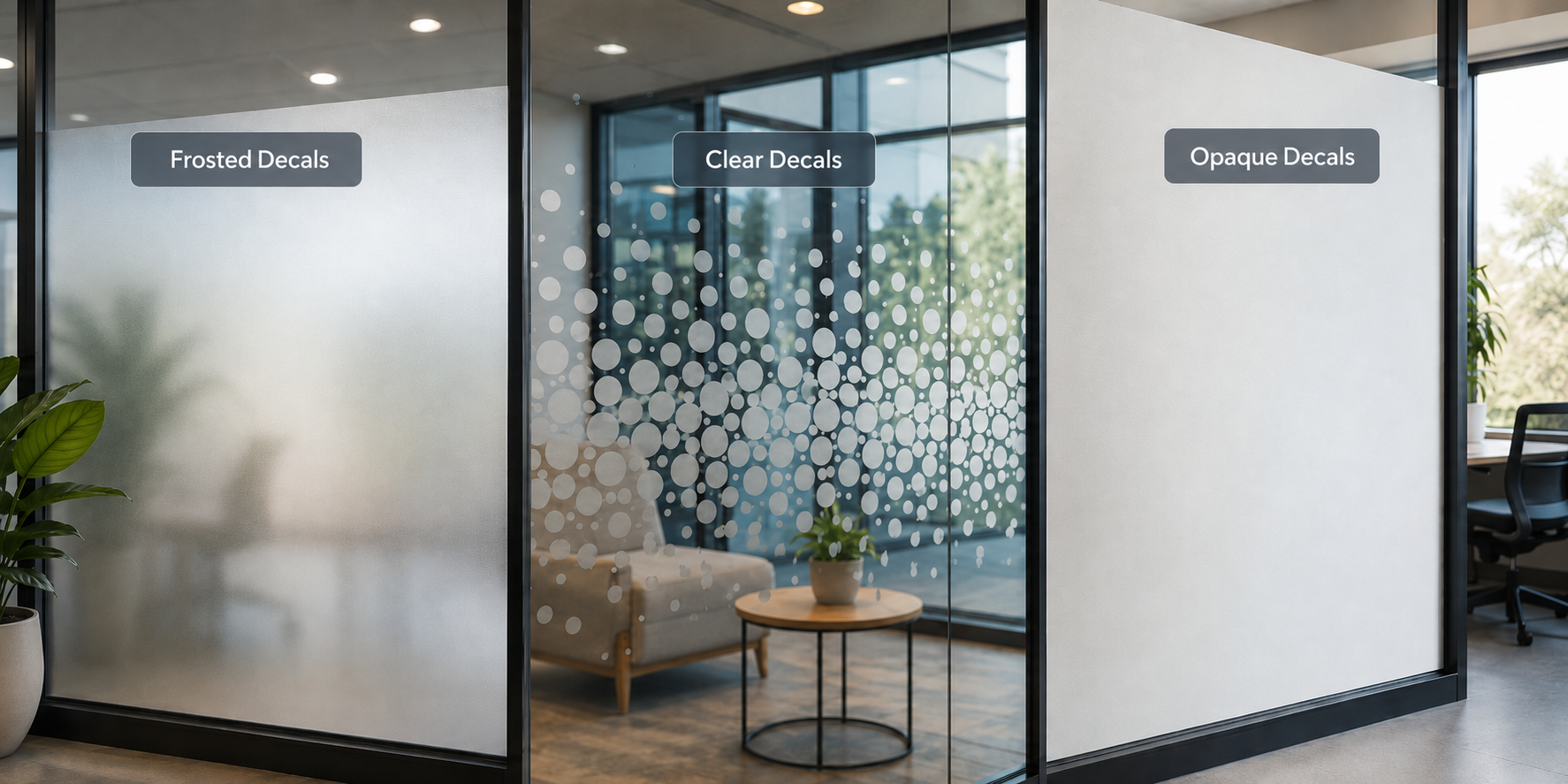
Clear decals sit on a transparent vinyl base. Glass stays visible everywhere except wherever the ink actually is. So you see the design - logo, text, whatever - and the rest of the window looks completely untouched.
Storefront branding is probably the most common use. A logo on clear vinyl lets people see straight into the shop while still marking it clearly from the sidewalk. Real estate offices use these for listings on glass doors. Restaurants for menus taped, well, printed, right onto the entrance.
Where it gets tricky: since the base is transparent, contrast matters a lot. White text against a bright sky? Good luck seeing it. White ink backing behind the design usually solves that, but not every shop includes it automatically - worth asking.
Frosted Window Decals
Frosted decals fake the look of etched or sandblasted glass. Translucent, matte film, lets light through but blurs whatever's on the other side. Unlike clear decals, frosted vinyl usually covers a bigger chunk of the window rather than just a logo, and that's really where the privacy angle comes from.
Custom window decals in frosted vinyl show up constantly in office settings - conference rooms, private offices, glass-walled meeting spaces. Changing rooms and bathroom windows too, for obvious reasons. And because it just looks more expensive than a plain sticker, a lot of businesses cut a logo directly into the frosted pattern, so light traces around the shape while the shape itself stays solid.
Downside: it cuts visibility in both directions. A storefront trying to look open and inviting probably shouldn't wrap the glass in frosted film - that works against the whole point. It also skews a bit corporate, minimalist, which isn't every brand's vibe.
Opaque Window Decals
Opaque decals just block everything. No light through the printed section, no visibility either direction. Basically a sign that happens to be stuck to glass instead of mounted on a panel.
Full privacy's the main draw here. Treatment rooms, storage areas facing the street, secure offices - anywhere sightlines genuinely need to be cut, opaque's usually the answer. Also handy for hiding an ugly view, or covering construction, without actually building anything.
They're also just the better pick for bold, large graphics. Colors come out more accurate since there's no glass tint or transparency messing with how the ink reads.
Trade-off: zero natural light through the covered section, which isn't ideal for spaces that depend on windows for daylight. And they read more like a solid sign than a subtle branding move, which can feel heavier than clear or frosted depending on the space.
Comparing the Three
| Factor | Clear | Frosted | Opaque |
|---|---|---|---|
| Visibility through glass | Full, except design | Blurred | None |
| Privacy level | Low | Moderate | Full |
| Best for | Branding, logos | Offices, privacy glass | Full blockout, signage |
| Light transmission | High | Moderate | None |
| Typical look | Subtle | Upscale, matte | Bold, solid |
Which One Fits What You Actually Need
Want branding without blocking the view? Clear. Logo reads fine, storefront still feels open from the street.
Need privacy but still want some light? Frosted splits the difference - offices, conference rooms, bathroom windows all do well here.
Need full privacy, or just a big solid graphic? Opaque's the only one that actually blocks the view completely. Treatment rooms, back offices, storage windows - anywhere sightlines really matter.
Need a bit of everything? Plenty of businesses mix types. Frosted for a private office, clear branding on the main entrance, opaque on a storage window nobody's supposed to see into.
A Few Notes on Material and Installation
Most decals are vinyl - either self-adhesive for something permanent, or static-cling if it needs to come down later. Static cling uses suction instead of glue, so it's easy to reposition or pull off without residue. Good for seasonal stuff or rented spaces.
Installation trips people up more than expected. Bubbles, crooked alignment, uneven edges - all common when the glass isn't cleaned properly first or nobody used a squeegee to push the air out during application. Small details, but they're the difference between looking professional and looking sloppy.
UV-resistant ink is worth asking about no matter which type you pick, especially for anything facing direct sun most of the day. Untreated ink can fade in a matter of months on a south-facing window. Treated vinyl usually holds up for years instead.
Making the Call
Honestly, there's no "best" one out of the three - it depends entirely on what the window's supposed to do. Clear works when you want both visibility and branding. Frosted works when privacy and light both matter. Opaque works when privacy matters more than anything else in the room.
Once you know the actual goal - branding, privacy, blocking a view, some mix of those - the choice gets a lot easier. After that it's really just confirming material quality, adhesive type, and UV resistance before ordering, so whatever goes up actually holds up as long as it's supposed to.