
Custom Flags for Business: Types, Uses, and Buying Guide
Flags have marked territory and signaled identity for centuries. Businesses use them for a similar reason today, just on a smaller scale. A flag outside a shop, booth, or event tent does something a printed sign can't - it moves. And motion is what catches a person's eye first, before they even register the words on it.
That's part of why so many storefronts, real estate offices, and event organizers still lean on flags. Not because they're trendy, but because they work, and they've kept working for decades.
Below is a rundown of the main flag types, where each one fits best, what actually matters when buying one, and a few notes on keeping a flag looking good past its first season.
Why Flags Still Work for Marketing
Three things happen at once with a flag that don't happen with most other signage. It's visible from far away. It reads from more than one angle. And it moves, constantly, without any effort on your part. A static poster can't do that.
Picture a storefront on a busy street. Someone driving past is going to notice a flag snapping in the wind way before they'd ever catch a sign bolted flat to the wall. It's just how attention works. The same holds true at a trade show, where personalized flags rising above the booth next to yours can be the whole difference between getting noticed and getting walked right past.
There's also the cost side of it. Compared to a billboard or a digital display, a flag is cheap, and it isn't a one-time expense either - a decent one lasts for several seasons, gets moved between locations, and can be swapped out when a promotion changes.
Main Types of Custom Flags
Not every flag shape does the same job. Picking the right one comes down to where it'll sit, how much wind it'll deal with, and how much text or artwork actually needs to fit on it.
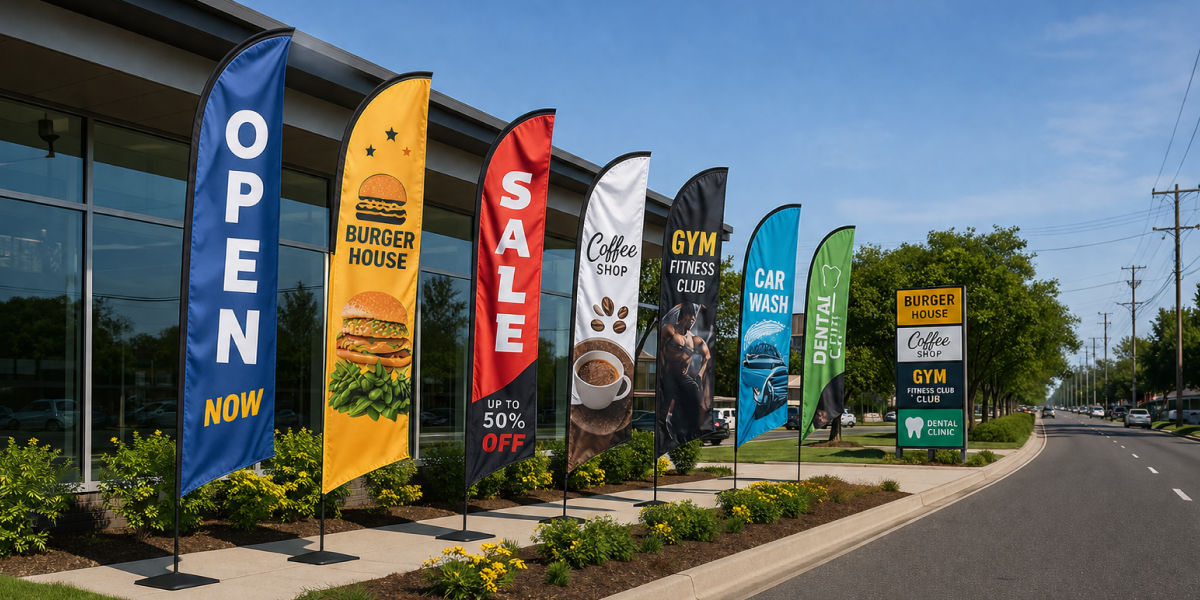
Feather flags : are tall and narrow, curving slightly at the top - hence the name. They're a go-to for roadside spots because that shape holds up in light-to-moderate wind, and the height makes them easy to spot from a car. Gas stations, retail stores, and seasonal pop-ups use these constantly.
Teardrop flags : curve at both the top and bottom, which keeps the fabric pulled tight instead of bunching up around the logo. They read as a bit more polished than a feather flag, which is probably why real estate offices and car dealerships tend to reach for this style over the others.
Blade flags : are rectangular and flat, with more surface area than either of the shapes above. That extra room matters when there's a longer message or a bigger logo that needs to stay readable from a distance - directional flags at large events are a common example.
Hand flags : are smaller, meant to be held rather than staked into the ground. Parades, rallies, and sporting events use them often, mostly because handing them out turns the crowd itself into part of the display - brand visibility that spreads well past wherever the flag started.
Triangle flags : usually strung together as bunting, aren't really informational - they're there to mark a boundary or add some visual energy to an event space. Think entrances, vendor rows, or the edge of a festival grounds.
Where Businesses Actually Use These
Storefronts : A flag near the entrance tells passing traffic the business is open, right now, without anyone having to read a sentence. Retailers lean on this for grand openings and seasonal sales, but plenty just keep one up year-round as a landmark customers learn to recognize.
Trade shows : Dozens of booths crammed into one hall means everyone's fighting for the same glance. A flag that clears booth height gives attendees something to walk toward from across the room - it's basically a landmark in an otherwise flat, repetitive space.
Real estate : Open houses and new developments use flags constantly, mainly for drive-by visibility. In neighborhoods where sign regulations are tight, a flag can sometimes do what a yard sign legally can't.
Festivals and outdoor events : Organizers use them to mark sponsor zones, vendor rows, and entrances. Because a flag moves the same way a crowd does, it tends to blend into the energy of the event instead of sticking out as an ad.
Fleet advertising : Smaller flags mounted on delivery vans or company cars turn an ordinary drive across town into free impressions - no extra cost beyond the flag itself.
What Actually Matters When Buying One
Material : Polyester is the standard for a reason - it holds color, resists tearing, and dries fast after rain. When comparing options, ask whether the printing uses dye-sublimation or bleed-through methods. Without it, the design only shows properly on one side of the fabric, which looks cheap from behind.
Weather resistance : A flag lives outside, usually in direct sun. If the ink and fabric aren't UV-treated, expect noticeable fading within a season, sometimes less.
Base and pole setup : This depends entirely on where it's going. Ground stakes are fine for grass. Cross bases work better on pavement or indoors. Water-fillable bases add weight for windier spots. And if the flag needs to move between locations often, a telescoping pole makes transport a lot less annoying.
Size : Most flags run somewhere between 8 and 16 feet tall. Taller means more visibility, but also a heavier base requirement - and sometimes a local height ordinance to check first. Smaller sizes make more sense indoors or in tight outdoor spots.
Print quality : This one's easy to overlook until it's too late. A logo that comes out blurry or pixelated defeats the entire purpose. High-resolution, full-color printing matters especially if the design includes gradients or photos rather than flat colors.
Keeping a Flag Looking Good Longer
Nothing undercuts a brand faster than a flag that's faded, torn, or tangled around its own pole. A few habits go a long way:
- Bring flags in during severe storms - high wind is what actually causes fraying and pole damage, not everyday breeze.
- Rinse off dirt or salt buildup now and then, especially near the coast.
- Store them dry and rolled, not folded - folding leaves creases that don't come out.
- If one spot gets heavy year-round use, keep a second flag in rotation so each one gets a break.
So Which One Should You Get?
There's no universal answer here. A feather flag makes sense outside a gas station. A teardrop flag probably fits better outside a real estate office going for a cleaner look. A blade flag might be the only option if a trade show booth needs more room for text. It really comes down to location, how much needs to be said, and how much wind the spot usually gets.
Done right, personalized flags aren't a one-off purchase - they hold up as a long-term piece of a business's marketing, not something replaced every few months. Whether it's pulling attention to a storefront, standing out on a trade show floor, or marking out territory at an outdoor event, custom advertising flags are still one of the more cost-effective ways to get noticed.
Final Thoughts
What makes flags work is the combination - visible, mobile, and flexible enough to fit almost any setting. Get the type right, match it to where it's going, and don't skimp on materials, and a flag ends up being less of an expense and more of a fixture. Over time, it stops being just a marketing tool and starts being how people recognize the business at a glance.