
What Is the Difference Between Double-Sided and Single-Sided Banners?
If you've ever tried to order a banner for an event, a storefront, or a trade show booth, you've probably hit that one question somewhere in the product options: single-sided or double-sided?
It seems simple. But depending on where you're placing your banner, how people will walk past it, and what your budget looks like, the answer can actually matter quite a bit. Get it wrong and you've either spent more than you needed to, or you've put up a sign that half your audience never even sees.
This guide breaks it all down - what each type actually is, how they're made differently, where each one makes sense, and how to figure out which one fits your situation without overthinking it.
The Basic Difference, Without the Jargon
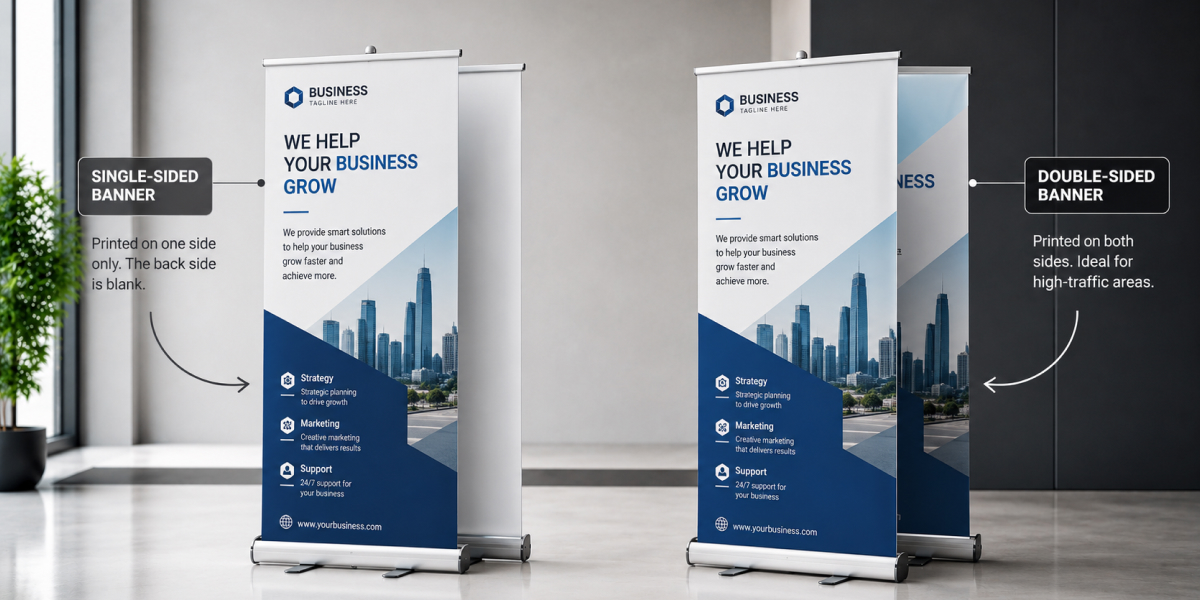
A single-sided banner has your design printed on one face only. The back is either blank, white, or shows a faint reverse ghost of the print. That's it. One viewing side.
A double-sided banner has your design printed on both faces - sometimes mirrored, sometimes with two completely different designs depending on the application. The idea is that people approaching from either direction see a complete, readable graphic.
That's the core difference. Everything else - cost, construction, material - flows from that one distinction.
How They're Actually Made (This Part Matters More Than You'd Think)
The construction method is where people often get confused, because "double-sided" doesn't just mean printing twice on the same sheet.
Single-Sided Banners
Most single-sided banners are printed directly onto a single layer of material - vinyl, polyester mesh, or woven fabric. The ink goes on, the banner gets finished with hems and grommets or pole pockets, and it's done. The back of a single-sided banner will often show some ink bleed-through on thinner materials, or it'll be a clean white or grey on thicker ones.
For a custom outdoor banner made this way, the material is usually a heavier vinyl (around 13oz to 18oz) precisely because that thickness blocks light bleed and keeps the back from becoming a problem. Nobody sees the back anyway, so the goal is just to make sure it doesn't detract from the front.
Double-Sided Banners
Double-sided construction is a bit more involved. There are two main approaches:
Two-layer sandwich construction: Two printed panels are produced separately and then bonded together - back to back - with a light-blocking liner in between. That liner is critical. Without it, the two prints bleed through each other and both sides look washed out. With it, each side is clean and opaque. This is the more durable, professional-grade method.
Direct double-sided printing: Some materials, particularly certain woven polyester and fabric banner substrates, can be printed on both sides directly without a separate liner. The weave of the fabric itself acts as a natural barrier to some degree, though results vary by material weight and ink density. A proper fabric banner made for double-sided use will typically be a heavier weave - around 200gsm to 280gsm - to handle the demands of print on both faces.
The liner-sandwiched method generally produces cleaner results, especially in direct sunlight where light transmission would otherwise make one side visible through the other.
Where Each Type Is the Right Call
The honest answer is that neither type is universally better. They're built for different jobs.
Single-Sided Makes Sense When:
Your banner hangs flat against a surface. If the back will be against a wall, a fence, a pipe-and-drape backdrop, or any solid surface - nobody will ever see it. Paying for double-sided printing in this scenario is genuinely wasted money.
Your audience approaches from one direction only. A banner stretched across the front of a stage, hung above a checkout counter, or placed at the back of a booth all share one thing: viewers stand in front of them. There's no "other side" in any practical sense.
Budget is a real constraint. Single-sided banners are consistently less expensive - sometimes 30% to 50% cheaper depending on size and material. For businesses running seasonal promotions or events that need ten banners instead of two, that difference adds up fast.
You need a quick turnaround. Single-sided production is faster. One print pass, one finishing step. If you're working with a tight timeline, this can actually be the deciding factor.
Double-Sided Makes Sense When:
Your banner will be suspended in open space. This is the clearest use case - hanging from a ceiling, suspended between two poles at a street festival, or strung across a walkway. People on both sides need to read it. A single-sided banner here means you've cut your visibility roughly in half.
You're using a retractable banner stand in a high-traffic aisle. If your stand sits in the middle of a corridor at a trade show rather than against a wall, people are walking past from both directions. A double-sided stand banner makes sure neither group sees a blank back.
The banner will move, rotate, or swing. Outdoor hanging banners in particular tend to shift in the wind. A single-sided banner that rotates will intermittently show its blank back to everyone. Double-sided solves this problem completely.
You want two different messages on one unit. Some businesses use double-sided banners to show different offers or information depending on which direction someone is traveling - a common approach in retail corridors and airport displays.
Material Considerations: Vinyl vs. Fabric
Material choice overlaps with the single vs. double-sided question in ways that affect both quality and cost.
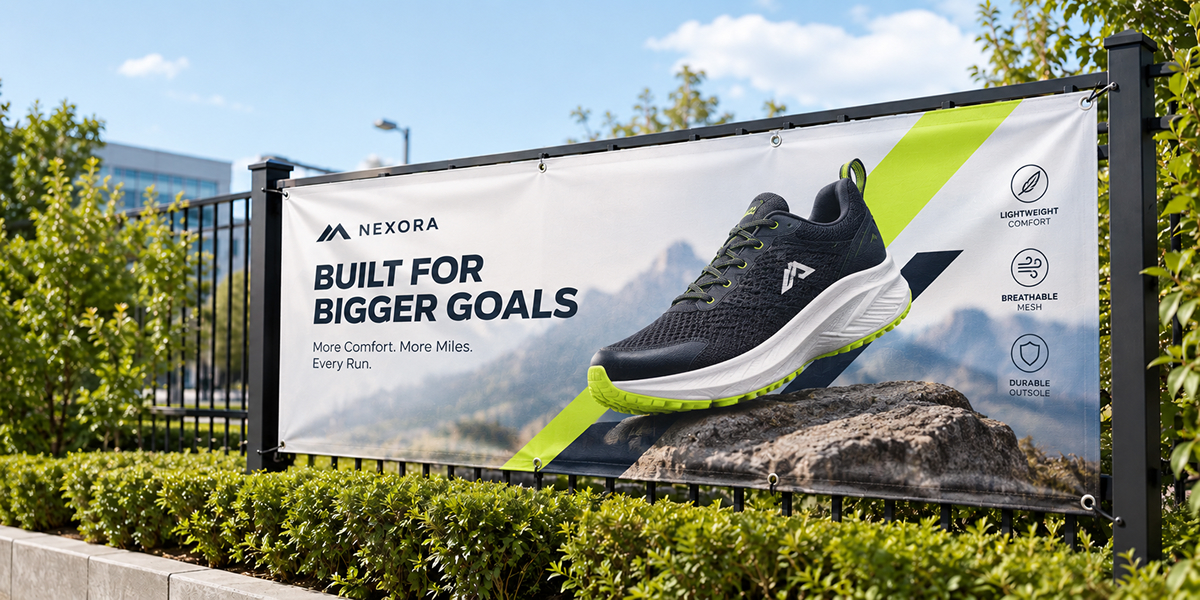
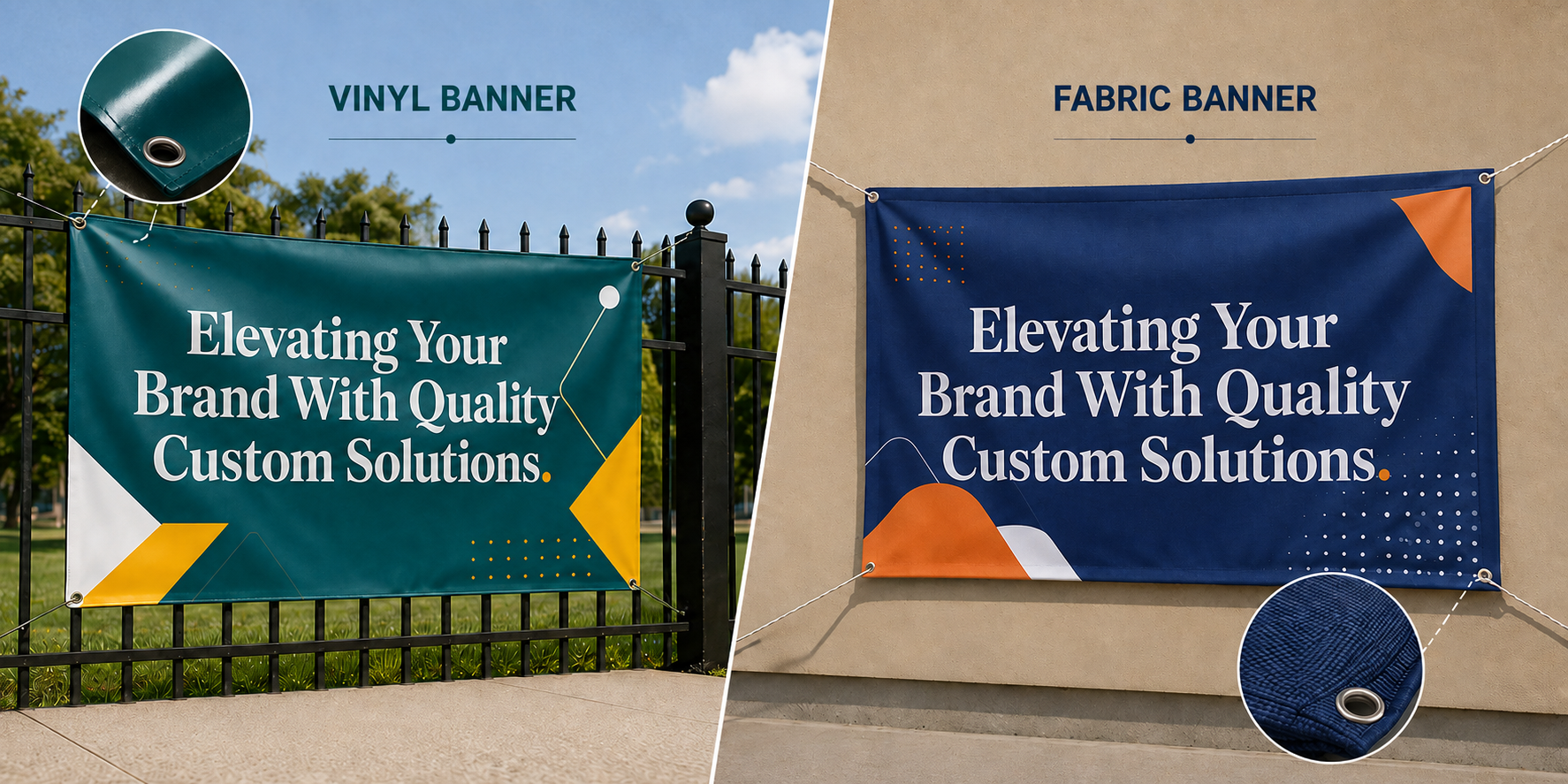
Vinyl is the most common material for outdoor single-sided banners. It's weather-resistant, relatively inexpensive, and easy to produce at almost any size. For most single-sided outdoor applications - storefront banners, fence wraps, event signage - heavy vinyl does exactly what you need it to do.
For double-sided outdoor applications, vinyl works but the liner-sandwich approach adds both weight and thickness. Large double-sided vinyl banners can become unwieldy in wind, which is why hardware matters a lot (more on that below).
Fabric is increasingly popular for both types - and it has a noticeably different look and feel. A proper fabric banner has a softer appearance, richer color depth, and a less "commercial" feel than vinyl. For indoor events, retail environments, and brand-focused displays, fabric often reads as more premium.
Cloth banner printing for double-sided use typically uses dye-sublimation - a process where heat-transferred dye penetrates the fabric fibers from both sides rather than sitting on the surface. The result is a banner that looks good from multiple angles, handles light differently than vinyl, and doesn't crack or peel over time.
That said, fabric does have limitations outdoors. It absorbs moisture, takes longer to dry, and isn't as resistant to prolonged UV exposure as quality vinyl. For a banner going up on a building exterior for three months, vinyl is usually the smarter call. For an indoor trade show display or a retail environment, fabric often wins.
Custom fabric banner printing has also gotten more accessible in the past several years - it's no longer just a premium option for large brands. Many print providers now offer fabric in standard sizes at reasonable price points, with options for either pole pockets or grommeted edges depending on your hardware.
The Hardware Question Nobody Talks About Enough
The banner material doesn't work in isolation — it works with whatever hardware holds it up. And for double-sided banners in particular, hardware matters a lot.
A double-sided banner that's just tied between two poles will often bunch, twist, and fold on itself. The standard solution is a banner stand, a tension frame, or spreader bars that keep the banner taut and flat from edge to edge.
For outdoor hanging banners - the kind strung above a street or between buildings - wind load becomes a real consideration. Double-sided banners have more surface area catching wind from both directions. This means:
-
The attachment points (grommets, pole pockets, D-rings) need to be reinforced
-
The substrate needs to have enough give to handle gusting without tearing - mesh or perforated materials are sometimes used outdoors for this reason
-
The rigging needs to be set up by someone who understands load distribution
Single-sided outdoor banners have it a bit easier here - they're typically hung flush against a wall or fence where wind load is minimal and attachment is straightforward.
Cost: What You're Actually Paying For
Here's a rough sense of the cost difference, without getting into specific prices that vary wildly by provider, size, and material:
A double-sided banner of the same size and material as a single-sided banner will generally run 20% to 60% more depending on construction method. The liner-sandwich approach is on the higher end because it's essentially two banners bonded together. Direct double-sided fabric printing can sometimes be more affordable because it skips the bonding step.
For custom fabric banner printing through professional print houses, you're also typically paying for more precise color management - the dye-sublimation process used on fabric requires different files and profiles than standard vinyl printing, so setup costs can be slightly higher on a first order.
What you're paying for with double-sided, when you actually need it, is genuine visibility. If your banner is in a position where both sides will be seen, paying for double-sided is not an extra - it's just the cost of doing the job correctly.
If you're not in that position, it's an easy place to save money without sacrificing anything.
A Few Scenarios to Make This Concrete
Scenario 1: Local restaurant hanging a "Grand Opening" banner across their storefront. This goes above the entrance, flat against the building facade. Everyone approaching from the street sees the front. Single-sided vinyl is the right call — it'll look great and cost less.
Scenario 2: A yoga studio at a weekend wellness fair, booth in the middle of an open floor plan. People will walk past the booth from both sides. A double-sided retractable banner stand placed at the edge of the booth means both traffic flows see the branding. Worth the extra cost here.
Scenario 3: A city event hanging sponsor banners on lamp posts along a parade route. Attendees line both sides of the street and walk both directions along the route. Lamp post banners here should absolutely be double-sided - though in practice, many event organizers print them single-sided to save budget and just accept that half the audience sees the back. The better call, especially for key sponsors, is double-sided with reinforced grommets.
Scenario 4: A boutique clothing store creating fabric displays for an interior retail floor. The displays hang from ceiling mounts in the middle of the floor space. Customers browse from all sides. Double-sided dye-sublimation fabric here makes sense, both for visibility and because the softer aesthetic matches the store environment better than vinyl would.
Scenario 5: A contractor ordering several site banners for a construction fence. These mount flat against temporary hoarding around a job site. Single-sided, heavy vinyl, done. No reason for anything more complicated.
What to Check Before You Order
A few things worth confirming before placing an order:
Where exactly is the banner going? Not "outdoors" generally, but specifically - against a wall, hanging free, on a fence, inside a venue. The answer to this single question usually determines single vs. double-sided on its own.
Will both sides actually be visible? If there's any chance the banner might swing, rotate, or be approached from behind, double-sided is worth it. If it's definitively against a surface, don't pay for it.
What's the viewing distance? For banners that will be read from a distance, clarity matters more than material type. Both vinyl and fabric can look excellent at distance - what kills readability at distance is small text and low contrast, not material choice.
How long will it be up? For a one-day event, an economy-grade single-sided banner is perfectly reasonable. For something going up for six months outdoors, material quality and UV resistance should be a bigger part of your decision than single vs. double-sided.
Do you have the right file? Double-sided orders - especially fabric - often require separate files for each side, set up correctly as mirrored or separate designs depending on the application. Sending one file and expecting a print provider to figure it out can lead to errors. Confirm the file requirements before ordering.
A Quick Reference
| Situation | Recommended Type |
|---|---|
| Against a wall or solid surface | Single-sided |
| Hanging free in open space | Double-sided |
| Retractable stand against a wall | Single-sided |
| Retractable stand in open aisle | Double-sided |
| Street-hanging or lamp post banners | Double-sided |
| Trade show back wall | Single-sided |
| Trade show center-floor display | Double-sided |
| Indoor fabric display, open floor | Double-sided |
| Outdoor event fence or barricade | Single-sided |
| Budget-sensitive multi-banner order | Single-sided where possible |
The Short Version
Single-sided banners are the right choice whenever the back of the banner won't be seen - which is actually the majority of banner applications. They're less expensive, easier to produce, and perform perfectly well for wall-mounted, fence-mounted, or one-directional display use.
Double-sided banners exist to solve a specific problem: audiences approaching from both directions. When that's your situation, a single-sided banner genuinely does half the job. When it's not your situation, double-sided is a cost with no corresponding benefit.
The material question - vinyl versus fabric - is somewhat separate from the single vs. double-sided question, though they often come up together. Fabric tends to work better in interior and brand-forward contexts. Vinyl handles outdoor durability better for most applications. Both are available in single and double-sided configurations.
Most print providers who do custom outdoor banners and cloth banner printing can walk you through the options for your specific use case - and if yours can't, that's worth knowing too.
Urvish
Ureshs